Rated puzzles are the backbone of most tactics training. You solve a position, your rating goes up or down, and the next puzzle is chosen to match your new level. Done well, it is one of the most efficient ways to sharpen your tactics. Done badly, it trains guessing, and the rating ends up measuring luck.
This guide explains how rated training works, what your puzzle rating does and does not tell you, and how to solve so that it reflects real skill, with a real puzzle from Lumichess Puzzle Training worked through.
The short version
- Rated training matches each puzzle to your rating and adjusts after every attempt, so the difficulty follows you.
- A new rating moves in big steps and settles as you solve more. The question mark shows it is still settling.
- Your puzzle rating is not your game rating. Comparing the two is misleading.
- Solve completely before your first move. Guessing trains guessing.
How rated training works
Every puzzle has a rating of its own, based on how real players have performed on it. Your puzzle rating is compared with it before each attempt. Solve it and your rating rises; miss it and it falls. Then the next puzzle is chosen close to your new rating, so you are always working at the edge of what you can do, without having to pick a difficulty yourself.
Lumichess puzzles come from the open Lichess puzzle database: millions of positions taken from real games rather than composed problems. That matters. A composed problem teaches an elegant idea you may never meet again. A position from a real game is one somebody actually had to find over the board.
How your puzzle rating moves
How much a single puzzle moves your rating depends on two things. The first is the gap between the puzzle's rating and yours: solving a puzzle rated well above you is worth more than solving an easy one, and missing an easy one costs more than missing a hard one. This is the same idea behind every chess rating, explained in how Elo ratings work.
The second is how settled your rating is. A brand-new rating is a guess, so it moves in big steps until the system has seen enough of your solving. That is why a new rating is shown with a question mark, like the 1500? in the screenshot below, and why your first puzzles can swing it a long way. As you solve more, the steps get smaller and the number starts to track your level.
Your puzzle rating is shared across Puzzle Training, the daily puzzle and Elo Maxing, so it is one number wherever you solve.
Puzzle rating versus game rating
It is tempting to compare your puzzle rating with your Chess.com or Lichess rating. Do not read too much into the gap. A puzzle tells you that a tactic exists in the position; a game never does. In a game you also have to notice the moment, manage your clock and play the quiet moves in between. Many players have a puzzle rating well above their game rating, and that is normal.
What your puzzle rating does measure well is your tactical pattern recognition when you know to look. Watch its trend, not its level. A rising puzzle rating over a few months is a good sign that your tactics are sharpening, even before your game rating catches up.
A real puzzle, worked through
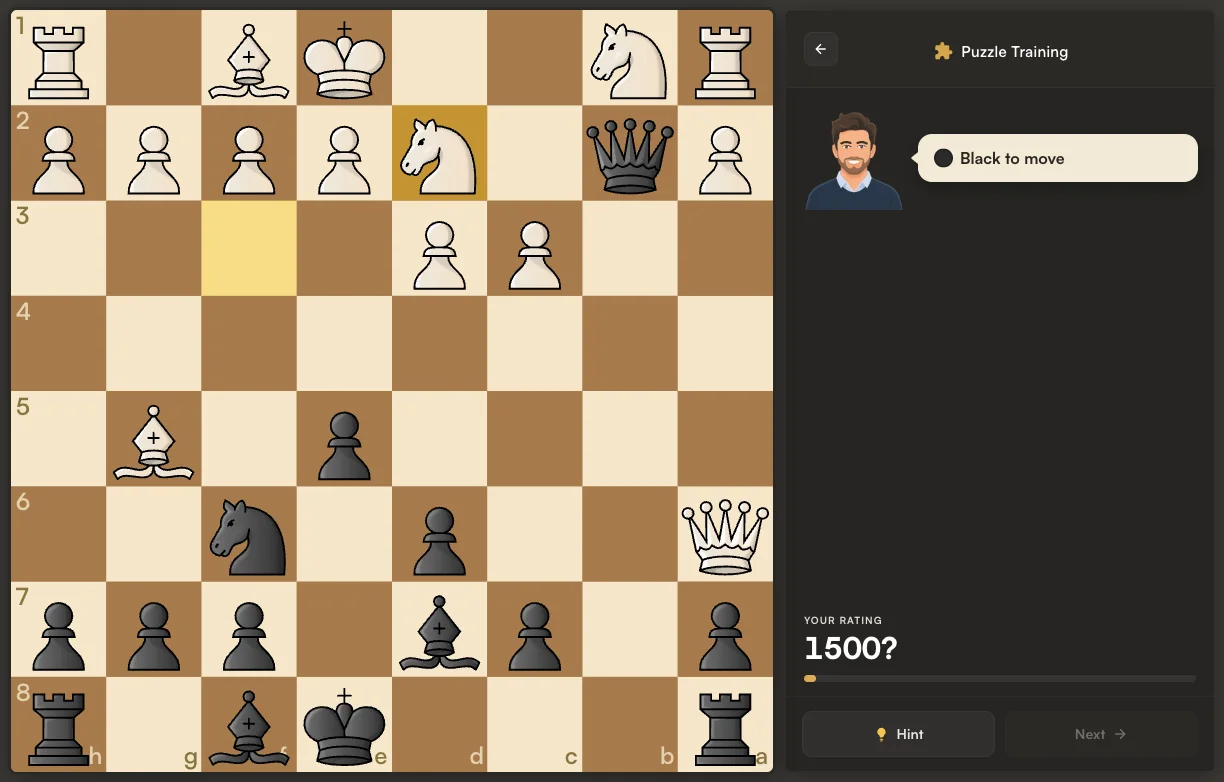
Every puzzle starts after your opponent's move, and that move is usually the reason the puzzle exists. Here White has just retreated the knight from f3 to d2. It looks like a solid, defensive move.
Now look at the white king on e1 and count its escape squares. The knight on d2 has just taken one of them away, and the pawns on e2 and f2 and the bishop on f1 block the rest. Then look at checks. 1...Qc1#: the queen slides from b2 to c1 and checks along the first rank, d1 is covered by the queen, d2 is blocked by White's own knight, and nothing can take the queen on c1. It is checkmate in one.
What the puzzle teaches
A defensive move can cost the king its last escape square. Whenever your opponent retreats a piece next to their own king, look at checks straight away.
Solving well rather than fast
The most common mistake in rated training is playing the first move that looks good, to see what happens. Puzzles with longer solutions will often accept a plausible first move and then present a reply you had not considered, and correcting from there trains guessing rather than calculation. It also makes your rating a measure of luck.
- Read the setup move. What did the opponent's last move change?
- Find what is loose or exposed: an undefended piece, a king short of squares, two pieces on one line.
- Look at forcing moves only: checks, captures and direct threats. The solution is nearly always one of them.
- Calculate to the end, including your opponent's best defence, and only then play.
- When you miss one, find the reply you overlooked before moving on. It is usually a defensive resource, not a pattern you did not know.
If a puzzle beats you completely, use the hint rather than the solution. Finding it with a nudge still builds the pattern.
Where rated training fits
| Training | What it builds |
|---|---|
| Puzzle Training | Calculation at your level, on positions you have never seen. |
| Elo Maxing | Your weakest tactical motifs, measured one by one. |
| Woodpecker | Instant recall of a fixed set, through repetition. |
| Puzzle Storm | Recognition speed against a clock. |
| Learn from Mistakes | The exact positions you got wrong in your own games. |
Rated training is the everyday workhorse; the others each fix a specific gap. To find out which gap matters most for you, find your chess weaknesses from your last 40 games first.
Frequently asked questions
How does rated puzzle training work?
Each puzzle has its own rating. Your rating is compared with it, goes up when you solve and down when you miss, and the next puzzle is chosen near your new rating.
Why did my puzzle rating change so much at the start?
A new rating is uncertain, so it moves in big steps until the system has seen enough of your solving. It settles as you solve more.
What does the question mark next to my rating mean?
That your rating is still provisional. It comes off once your rating has settled.
Why is my puzzle rating higher than my game rating?
Because a puzzle tells you a tactic exists, and a game does not. It is normal for the two to differ; watch the trend of your puzzle rating rather than comparing the numbers.
Where do the puzzles come from?
From the open Lichess puzzle database, positions taken from real games and rated by how real players performed on them.
Is it better to solve fast or accurately?
Accurately. Calculate the whole line before your first move. Speed training belongs in timed modes like Puzzle Storm.