A timed puzzle run is one of the most addictive formats in chess. The clock is running, the puzzles keep coming, and every solve pushes your score up. Chess.com calls it Puzzle Rush. Lichess calls it Puzzle Storm. The idea is the same: solve as many tactics as you can before time runs out, while the puzzles get harder.
It is also a genuinely useful kind of training, as long as you understand what it trains. This guide explains how the format works, what it is good for, and the habits that raise your score, with one real position from a Lumichess Puzzle Storm run worked through.
The short version
- A timed run trains recognition: seeing the tactic before you have calculated it.
- Puzzle solutions are forcing, so look at checks, captures and threats first, every time.
- Watch the setup move. The opponent's move that starts each puzzle is usually the reason the tactic exists.
- Do not stare. A wrong answer costs one puzzle; a long stare costs several.
- Judge yourself by your trend across runs, not by one score.
How a timed run works
Lumichess Puzzle Storm has three formats. You pick one before you start:
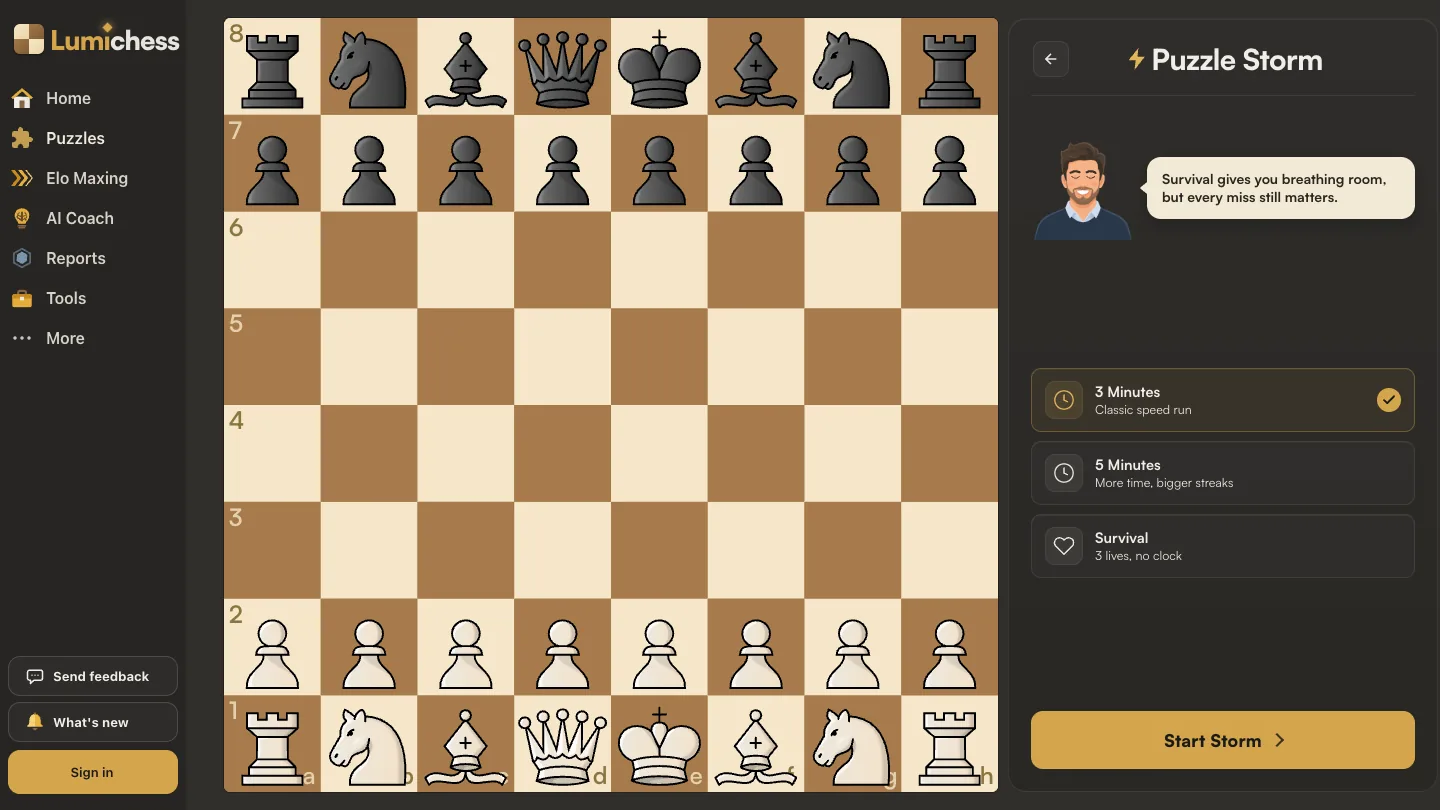
| Format | How it ends | Best for |
|---|---|---|
| 3 minutes | When the clock runs out. | A quick, sharp session. |
| 5 minutes | When the clock runs out. | Longer streaks and harder puzzles. |
| Survival | When you have used your three lives. No clock. | Accuracy without time pressure. |
In every format the puzzles start easy and get harder as you solve. In the timed formats a wrong answer does not end the run: it moves you straight to the next puzzle, with no retry, and it breaks your combo. Combos matter, because a streak of correct answers adds time to the clock. So a clean run extends itself, and a run full of guesses runs out early. Accuracy buys time.
Storm is free, with unlimited runs, and you can start without an account. The puzzles come from the open Lichess puzzle database, rated by how real players performed on them.
What it trains, and what it does not
Under a clock you cannot calculate every line to the end, so you are forced to rely on recognition: seeing that a position has a loose piece or a weak back rank before you have worked out the moves. That is a different skill from calculation, and it is the one that decides most fast games.
A timed run also exposes a gap that slow solving hides. A pattern you can find in ninety seconds but not in five is not yet learned well enough to help you when your own clock is low.
What it does not train is depth. Timed runs reward the first good idea, not the careful check of a long line, and they can build a habit of guessing if you let them. Use them alongside slower training: rated puzzles with no clock, and the Woodpecker Method, which repeats a fixed set until the patterns are automatic.
A real Storm position
Here is a position from a Lumichess Storm run. Every Storm puzzle begins with your opponent's move, the setup move. Here Black has just played a knight from d4 to b5, and it is White to move:
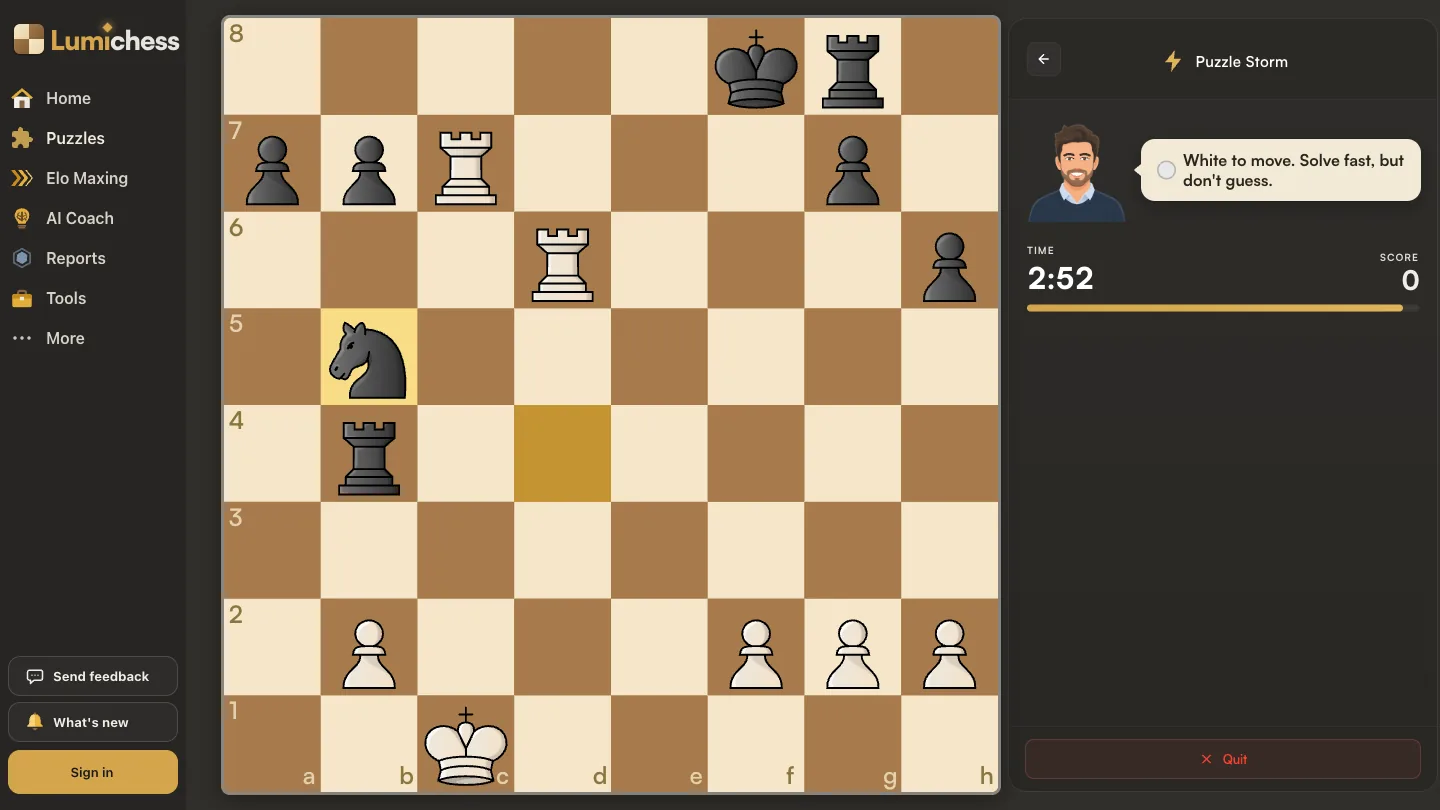
Start with the setup move. The knight on b5 attacks both white rooks, on c7 and d6: a fork. The natural reaction is to save a rook. That is the trap. In a puzzle, the setup move is usually a mistake, and the question is what it allowed.
So look at checks first. White has one worth seeing: 1.Rd8+. The black king on f8 cannot go to e8, which the rook on d8 covers, or to e7 and f7, which the rook on c7 covers along the seventh rank. It cannot go to g7 or g8, where its own pawn and rook stand. And nothing can block on e8. It is checkmate. Black's knight was busy forking rooks while the king ran out of squares.
That is the whole method in one position: read the setup move, then look for checks, captures and threats before anything else.
Eight habits for a higher score
- Forcing moves first, always. Puzzle solutions are forcing by construction. Scanning quiet moves in a timed run is almost always wasted time.
- Read the setup move. Ask what the opponent's last move left undefended, or what square it gave up.
- Count attackers and defenders on the piece you want to win. A capture that looks free often is not, because of one defender you did not count.
- Check the king's escape squares. Many quick tactics are mates, and they are faster to see if you glance at the king first.
- Go fast early. The first puzzles are easy. Bank the time and the combo while you can.
- Do not fight a position you cannot see. If nothing appears in a few seconds, play the most forcing candidate and move on.
- Protect the combo. Because streaks buy time, one careful extra second is often cheaper than a miss.
- Stop when you are tired. Tired solving turns into guessing. Three focused runs beat ten tired ones.
Expect every run to beat you
The difficulty keeps rising for as long as you keep solving, so every run is designed to end in positions you cannot solve in time. Ending on a hard puzzle is the format working, not a bad run.
The patterns worth knowing cold
Most puzzles in a fast run are built from a small set of motifs. The more of these you see instantly, the longer your runs get:
| Pattern | What to look for |
|---|---|
| Back-rank mate | A king behind its own pawns with no escape square, and an open file for a rook or queen. |
| Fork | One piece, very often a knight or queen, attacking two valuable targets at once. |
| Pin and skewer | Two pieces on the same line as a king or queen. |
| Discovered attack | A piece that can move out of the way of a rook, bishop or queen behind it, with tempo. |
| Hanging piece | Anything left undefended by the setup move. |
| Removing the defender | Capture or deflect the one piece guarding a key square. |
If one of these keeps ending your runs, drill it directly: the Woodpecker trainer has theme sets for single motifs, including forks, pins, skewers, discovered attacks and back-rank mates.
What to do after a run
When a run ends, the results screen shows every puzzle you met, marked solved or missed. Look at the misses, not the score. Were they all the same kind of tactic? Did they come in the first minute, when you were rushing, or at the end, when the puzzles got hard? The answer tells you what to practise.
Then look beyond puzzles. A motif you keep missing in Storm is often costing you in real games too. Mistake training gives you back the positions you got wrong in your own games, and a Profile Report shows how often tactics decide your results across your last 40 games.
Frequently asked questions
Is there a free Puzzle Rush?
Yes. Lumichess Puzzle Storm is the same format: a timed run of tactics that get harder as you solve. It is free, with unlimited runs, and you can start without an account.
What is the difference between Puzzle Rush and Puzzle Storm?
They are the same idea under two names. Chess.com calls it Puzzle Rush and Lichess calls it Puzzle Storm. The puzzle sets, time options and rules differ between sites.
Does a wrong answer end the run?
Not in the timed formats. A wrong answer moves you to the next puzzle and breaks your combo. In Survival, which has no clock, a run ends when you have used your three lives.
How do I get a higher Puzzle Rush score?
Look at checks, captures and threats first, read what the opponent's setup move allowed, move on quickly from positions you cannot see, and protect your combo, because streaks earn extra time.
Is Puzzle Rush good for improving at chess?
Yes, for pattern recognition under time pressure. It does not train deep calculation, so combine it with untimed puzzles and a repetition method such as Woodpecker.
Where do the puzzles come from?
From the open Lichess puzzle database, taken from real games and rated by how real players performed on them.