Almost every chess player does puzzles, and a lot of them do not get noticeably better at tactics. The reason is usually the same. They solve a fresh puzzle, get it right or wrong, and move on. They never see that exact pattern again until it turns up in a real game, and by then it is too late.
The Woodpecker Method attacks that problem head on. Instead of an endless stream of new puzzles, you solve one fixed set, then solve the same set again, and again, faster each time, until the positions stop being problems you calculate and become shapes you recognise. This guide covers where the method comes from, why it works, how to run it properly, and how to do it online without the bookkeeping.
The short version
- The Woodpecker Method means solving one fixed set of puzzles in repeated cycles, each faster than the last.
- It works because tactics are won by recognition, not calculation, and recognition is built by meeting the same pattern again.
- Pick a set you can mostly solve on the first pass. Too hard a set is the most common way the method fails.
- Keep the set frozen, solve honestly with no hints, and stop when your times stop falling, usually somewhere between five and seven cycles.
- Use it alongside new puzzles and your own mistakes, not instead of them.
What the Woodpecker Method is
The method comes from The Woodpecker Method, a book by Axel Smith and Hans Tikkanen, published by Quality Chess. The name has two sources: the woodpecker, which strikes the same spot until it breaks through, and Tikkanen himself, whose surname means little woodpecker in Finnish.
The book is a collection of just over 1,100 tactical positions, and the instructions are simple. Solve the whole collection once, carefully. Then solve the same collection again in less time. Then again, in less time still. The positions never change between cycles. That is the whole point.
It sounds too simple to be a method. Most training advice pushes the other way: more variety, harder puzzles, new material every day. The Woodpecker Method bets that for tactics, depth beats breadth, and a small set you know cold beats a big one you have seen once.
Why repetition works
Watch a strong player look at a tactic and they rarely calculate it from scratch. They recognise it. A knight landing on c7 with the king on e8 and a rook on a8 is not a problem to solve; it is a shape they have seen hundreds of times. Studies of chess memory going back to the 1970s found the same thing: stronger players remember and read positions as meaningful chunks, not as pieces on separate squares.
That library of chunks is built by meeting the same patterns again and again. A puzzle you solve once gives you a little of it. A puzzle you solve seven times, each time faster, moves the pattern out of slow calculation and into instant recognition. In a real game, with the clock running, recognition is what you actually have time for.
There is a second effect. On the first pass you are learning to solve. On later passes, when you already half-know the answer, you are practising the act of seeing it, which is exactly the skill a game asks of you. Reading an answer you have forgotten feels like learning. Finding it again, faster, is learning.
Choosing the right set
The set decides whether the method works. Too easy, and you are practising what you already know. Too hard, and the first cycle drags on for weeks, you give up, and nothing is learned. A good set is one where you can solve most positions on the first pass with real effort, and a few defeat you.
| Set type | What it trains | Use it when |
|---|---|---|
| Mixed, at your level | A balanced spread of motifs at one difficulty. | You are starting out with the method, or want general sharpness. |
| One theme | A single motif, such as forks, pins or back-rank mates. | Your reviews keep pointing at the same motif. |
| One opening | The tactics that come out of a specific opening. | You keep walking into the same trick in your own repertoire. |
| Your own mistakes | Positions you actually got wrong in your games. | You want the sharpest material there is: patterns you have shown you miss. |
Size matters too. The book's 1,100 positions suit a player with months to commit. For most people a set of around fifty is far more realistic: small enough to finish a full cycle in one or two sittings, large enough to cover a real range of patterns.
Running the cycles
The rules are few, and each one exists for a reason.
- Solve the first cycle slowly. Get every position right, or find out properly why you did not. Speed comes later on its own.
- No hints, no engine, no skipping. A position you solved with help is a position you do not know. Counting it as solved only hides the gap.
- Keep the set frozen. Do not swap in new positions or drop the ones you hate. The ones you hate are the ones working hardest for you.
- Time every cycle, and write it down. Two numbers are enough: how many you solved cleanly, and how long the cycle took. Without them you cannot tell real progress from a good day.
- Aim to be faster and at least as clean. Speed bought with mistakes is not progress. If a cycle gets faster and sloppier, the next one should slow down.
- Put your misses aside. Keep a list of the positions you got wrong and go through them separately, so a few stubborn positions do not drag down the whole cycle.
Spacing helps. A cycle every few days works better than seven cycles crammed into a weekend, because recall that has had time to fade and is then rebuilt is recall that lasts.
When to stop
Seven cycles is a ceiling, not a target. The sign that a set is finished is not a number of passes but your times: once a cycle is barely faster than the one before, and you are solving almost everything on sight, the patterns are in. Most players reach that somewhere between the fifth and seventh cycle. Repeating a set you already recognise instantly trains nothing. Move on to a new set, or a harder one.
A realistic first month
Week one: the first cycle of one mixed set at your level, slowly. Weeks two to four: a cycle every three or four days, each timed, with your misses drilled separately in between. By the end of the month most sets are close to flattening, and you will know from your own times whether it worked.
How the method goes wrong
- A set that is too hard. If the first cycle feels endless, drop a level. The method needs repetitions, and a set you cannot finish gives you none.
- Memorising moves instead of reasons. By the third cycle you will remember some answers. That is fine, as long as you can say why the move works. If you cannot, treat it as a miss.
- Racing. Speed is a result of recognition, not a goal. A fast cycle full of guesses is worse than a slow clean one.
- Starting five sets at once. One set, finished properly, beats five abandoned halfway.
- Using it as your only training. It sharpens the patterns in the set. It does not teach you openings, endgames or how to review your games.
The Woodpecker Method online
You can run the method with the book, a notebook and a stopwatch. The trouble is the bookkeeping: timing each cycle, tracking which positions you missed, keeping the set honestly frozen. The Lumichess Woodpecker trainer does that part for you.
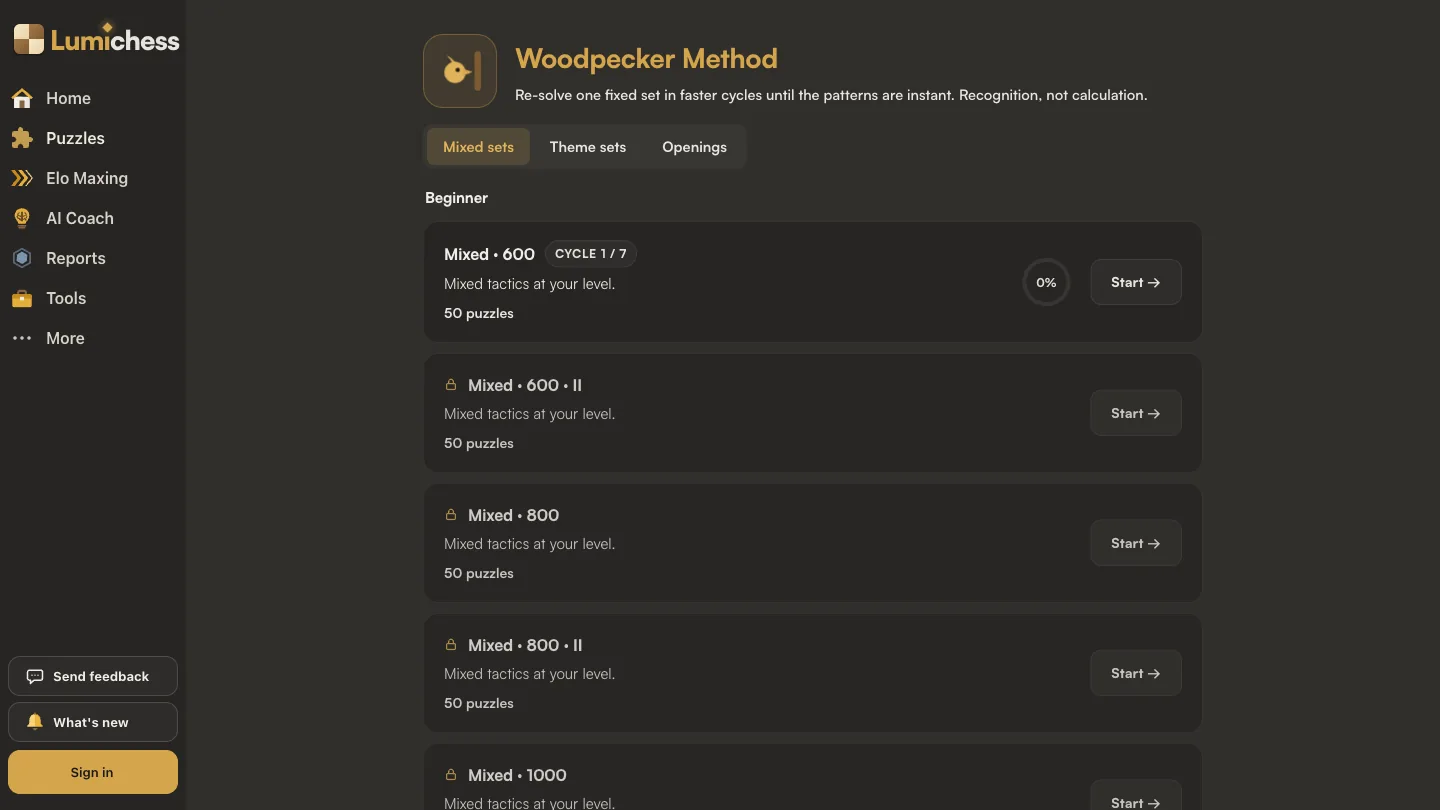
The catalog holds 580 fixed sets of 50 positions each, drawn from real games. Mixed sets are banded by rating from 600 upward. Theme sets drill one motif at a time: forks, pins, skewers, discovered attacks, deflection, interference, clearance, back-rank mates, quiet moves, promotion, endgames and more. Opening sets collect the tactics that arise out of one opening family. There is also a personal set built from the tactics you missed in your own games.
Every cycle is timed, and at the end of it the trainer keeps two numbers: how many positions you solved cleanly on the first try with no hint, and your average time per position. From the second cycle on, your previous cycle's numbers sit on screen as the target to beat. They are a target, not a barrier: a bad session still counts, and shows up honestly as a slower cycle. Anything you miss goes into a separate mistakes pool you can drill without disturbing the cycle, and when your times flatten out, the trainer marks the set as done so you can move on.
Where it fits with other puzzle training
The Woodpecker Method is one tool, and it works best next to the others:
| Training | What it builds | Where |
|---|---|---|
| Woodpecker cycles | Speed and certainty on a chosen set of patterns. | Woodpecker trainer |
| Rated puzzles | Breadth: a new position every time, at your level. | Puzzle training |
| Timed runs | Quick sight under pressure. | Puzzle Storm |
| Your own mistakes | The exact patterns you missed in real games. | Mistake training |
A simple week: rated puzzles for variety, one Woodpecker cycle for depth, and a few minutes on your own mistakes. To find out which motifs your games actually need, review your games first, or run a Profile Report over your last 1,000 games, then pick a theme set that matches what you keep missing.
Frequently asked questions
What is the Woodpecker Method in chess?
A tactics training method from the book by Axel Smith and Hans Tikkanen. You solve one fixed set of puzzles, then solve the same set again in less time, repeating for several cycles until the patterns are instant.
How many cycles should I do?
Up to seven, but stop earlier once your times stop falling and you solve almost everything on sight. Most players get there between the fifth and seventh cycle.
How many puzzles should a Woodpecker set have?
The book uses just over 1,100, which suits a long commitment. For most players a set of around 50 is more realistic: a full cycle fits in one or two sittings.
Is the Woodpecker Method good for beginners?
It works best once you know the basic motifs and need to spot them faster. Complete beginners usually do better learning what forks, pins and skewers are first.
Can I do the Woodpecker Method online for free?
Yes. You can start with a free account: sets of 50 positions at every level, with timed cycles and a mistakes pool, and your cycle history kept for you.
Is it bad that I memorise the answers?
Not if you also know why the move works. Recognising the answer quickly is the goal. If you remember a move but cannot explain it, count it as a miss.