Every chess player has a pile of lost games full of lessons they never learned. They saw the blunder in the review, winced, and moved on. A few weeks later they made the same kind of mistake again, because recognising a mistake once is not the same as never making it again.
The fix is simple and underused: take the positions where you went wrong and solve them again, as puzzles, until you find the right move without thinking. This guide explains why your own mistakes make the best training material, how to use them, and walks through a real one from a bullet game.
The short version
- Your own mistakes are the most personal puzzles there are: positions you really reached, at your level, and got wrong.
- Seeing a mistake once in a review is not enough. Re-solving it is what builds the pattern.
- Solve each position properly, and when you miss one again, find the reply you overlooked.
- In the example below, one rook check turned a forced mate in five into a draw.
Why your own mistakes are better puzzles
General puzzle sets are drawn from millions of games by other players, so they train tactics in proportion to how often those tactics appear in chess overall. That is a reasonable default, but it is not aimed at you. If you reliably miss discovered attacks and never miss a back-rank mate, a general set will keep giving you back-rank mates.
Positions from your own games skip that problem. Every one is a position you actually reached, at your rating, against the kind of opponent you really face, and one you have already shown you get wrong. There is no stronger evidence that a pattern needs work.
There is a second effect. Meeting the position again, knowing something is there, is very different from meeting it in a game where nothing warns you. Closing that gap is the whole point, and repeating your own missed positions is the most direct way to do it.
A real mistake, worked through
Here is a position from a real bullet game on Chess.com, served back by Lumichess Learn from Mistakes. The player had Black, and it is move 31, Black to move:
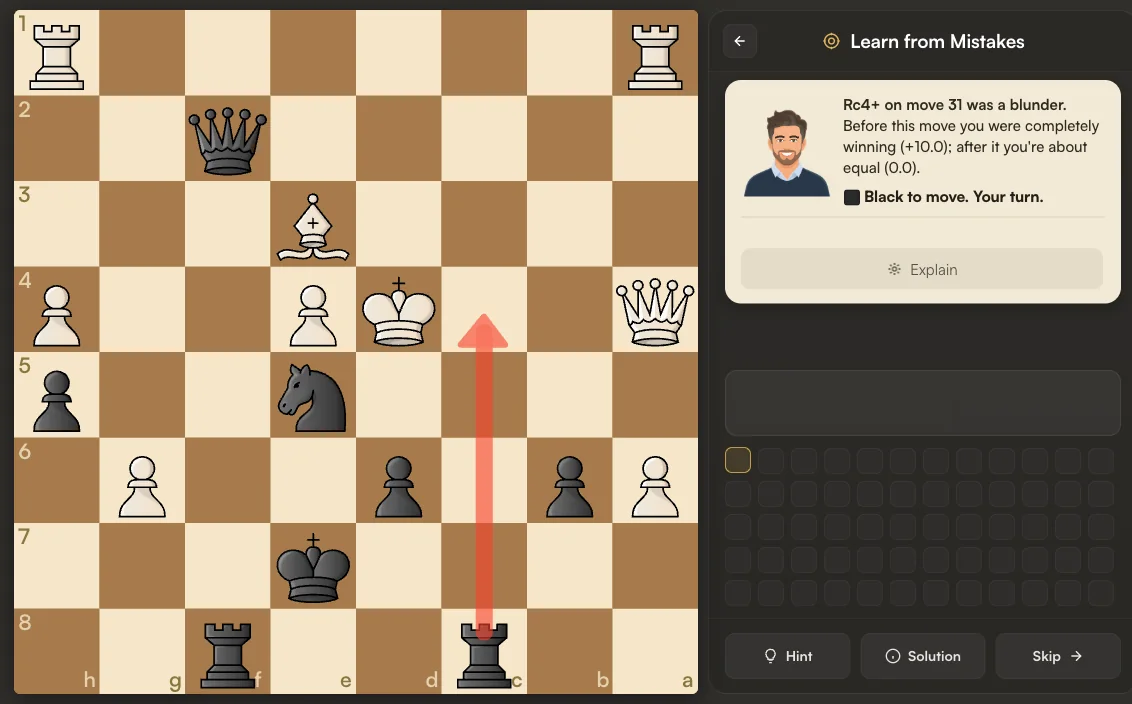
2r2r2/4k3/Pp1p2P1/4n2p/Q2KP2P/4B3/5q2/R6R b - - 0 31
In the game, Black played 31...Rc4+, checking the white king on d4. It looks natural: a rook check against an exposed king. But the queen on a4 simply takes it, 32.Qxc4, and the advantage is gone. The trainer puts it plainly: before this move Black was completely winning, after it the position is about equal.
What should Black have played? Stockfish finds a forced mate in five, starting with the quiet 31...Qe2, and another mate in five with 31...Rf3. The white king is standing in the middle of the board surrounded by Black's pieces, and the right idea is to close the net around it rather than give a check that lets White capture one of the attackers.
The lesson in one sentence
Before giving a check, ask what it lets your opponent do. A check that can simply be captured is not an attack; it is a gift.
That sentence is worth more than the position itself, because it applies to hundreds of future positions. It is exactly the kind of lesson a single review of the game tends to miss, and re-solving the position is what makes it stick. If you want to go deeper, Explain answers about this exact position, and you can paste the FEN above into the Analysis Board to play the mating lines out yourself.
How Learn from Mistakes works
Learn from Mistakes builds puzzles out of your own games. When your games are analysed, the positions where you played a move that lost material or evaluation are kept, and you are given them again, this time to find the move you missed.
- The move you played is shown as a red arrow, with a line from the coach on what it cost.
- Hint points you in the right direction without giving the answer away.
- Solution shows the right move when you are truly stuck.
- Explain tells you why, about that exact position.
- The game card shows which of your games the position came from.
Positions come from your analysed games, so the supply grows as you play and review. Connect a Chess.com or Lichess account and your recent games are pulled in automatically, or review a game in the Game Report and its mistakes become available to train.
How to train on your mistakes
- Solve it like a game position. Checks, captures and threats first, then your opponent's best reply. Do not guess.
- Use the hint before the solution. Finding it with a nudge still builds the pattern; reading the answer does much less.
- When you miss one again, name what you overlooked. Usually it is one reply: a capture, a block, an in-between move. That missing reply is the real lesson.
- Come back to the ones you missed. A position that beats you twice is telling you about a habit, not a single blunder.
- A few a day beats many once a week. Five or ten positions daily keep the patterns fresh.
What your mistakes say about your habits
After a few dozen positions, look at them together. Most players find their mistakes cluster: checks that let the opponent trade off an attacker, captures that walk into a pin, pawn moves that open their own king. Those clusters are habits, and a habit is far easier to fix once you can name it.
If the same motif keeps appearing, drill it directly with a Woodpecker theme set or Elo Maxing, which aims every session at the motifs you are weakest at. For the bigger picture, how to find your chess weaknesses shows how a 40-game report reveals which kind of mistake costs you most, and the AI Coach builds your own mistakes into a daily session automatically.
Frequently asked questions
How do I learn from my chess mistakes?
Re-solve the positions where you went wrong until you find the right move on sight. Learn from Mistakes pulls those positions from your own analysed games and serves them back as puzzles.
Why are my own mistakes better than normal puzzles?
Because they are positions you really reached, at your level, and already got wrong. That is the strongest evidence that a pattern needs work.
Where do the positions come from?
From your own Chess.com or Lichess games once they are analysed: the moments where the move you played lost material or evaluation.
What if I cannot find the move?
Use the hint first, then the solution. Afterwards, name the reply you overlooked, because that is usually the real lesson.
How many mistakes should I train a day?
Five to ten is plenty. A few every day keeps the patterns fresh better than a long session once a week.
Can I see which game a mistake came from?
Yes. Each position shows the game it came from, with the players, the time control and the opening.