Most people who decide to get better at tactics plan long training sessions. They do two of them, life gets in the way, and they stop. A daily puzzle works the other way round. It is one position, a few minutes at most, and it is small enough to survive a bad week.
That is the whole case for it. A daily puzzle will not transform your rating on its own, but a habit you actually keep beats a programme you abandon. This guide covers why it works, how to solve a puzzle properly rather than quickly, and walks through a real puzzle of the day from Lumichess, move by move.
The short version
- A daily puzzle is valuable because it is small enough to do every day.
- Because there is only one, solve it slowly and completely, like a position from your own game.
- Look at what is loose or exposed first, then at checks, captures and threats.
- Always work out the opponent's best reply before you commit.
- If you get it wrong, find the reply you missed. That is the lesson.
Why one puzzle a day works
Tactical skill is mostly recognition: seeing that a position contains a fork, a pin or a weak back rank before you have calculated anything. Recognition fades faster than understanding. You never forget what a pin is, but a few weeks without tactics and you get slower at spotting one.
A daily puzzle keeps that recognition warm between longer sessions, and it does so at a cost low enough that you will actually pay it. The value is not in any single puzzle. It is in the streak: returning to the board every day, even on days when you would otherwise not touch chess at all.
It also has a quieter benefit. Because there is only one puzzle, there is no temptation to rush to the next. You can treat it the way you should treat a critical position in your own games: slowly, completely, and honestly.
A method for solving it properly
- Read the position before you calculate. Whose move is it? What did the opponent's last move change? Which pieces are undefended? Where are the kings, and how many escape squares do they have?
- List the forcing moves. Every check, every capture, every direct threat. Puzzle solutions almost always start with one.
- Check the opponent's threats. A puzzle often looks quiet because the opponent is the one threatening something. The solution is usually a move that is faster than their threat.
- Calculate to the end. For each candidate, follow it until the position is clearly won, and at every step look for the opponent's best reply, not the reply you hope for.
- Only then move. If you are not sure, sit with it for another minute. Guessing teaches nothing; finding teaches everything.
A real puzzle of the day
Here is the Lumichess puzzle of the day for 23 September 2026, rated 1262. Black has just moved a rook from f8 to d8, and it is White to move:
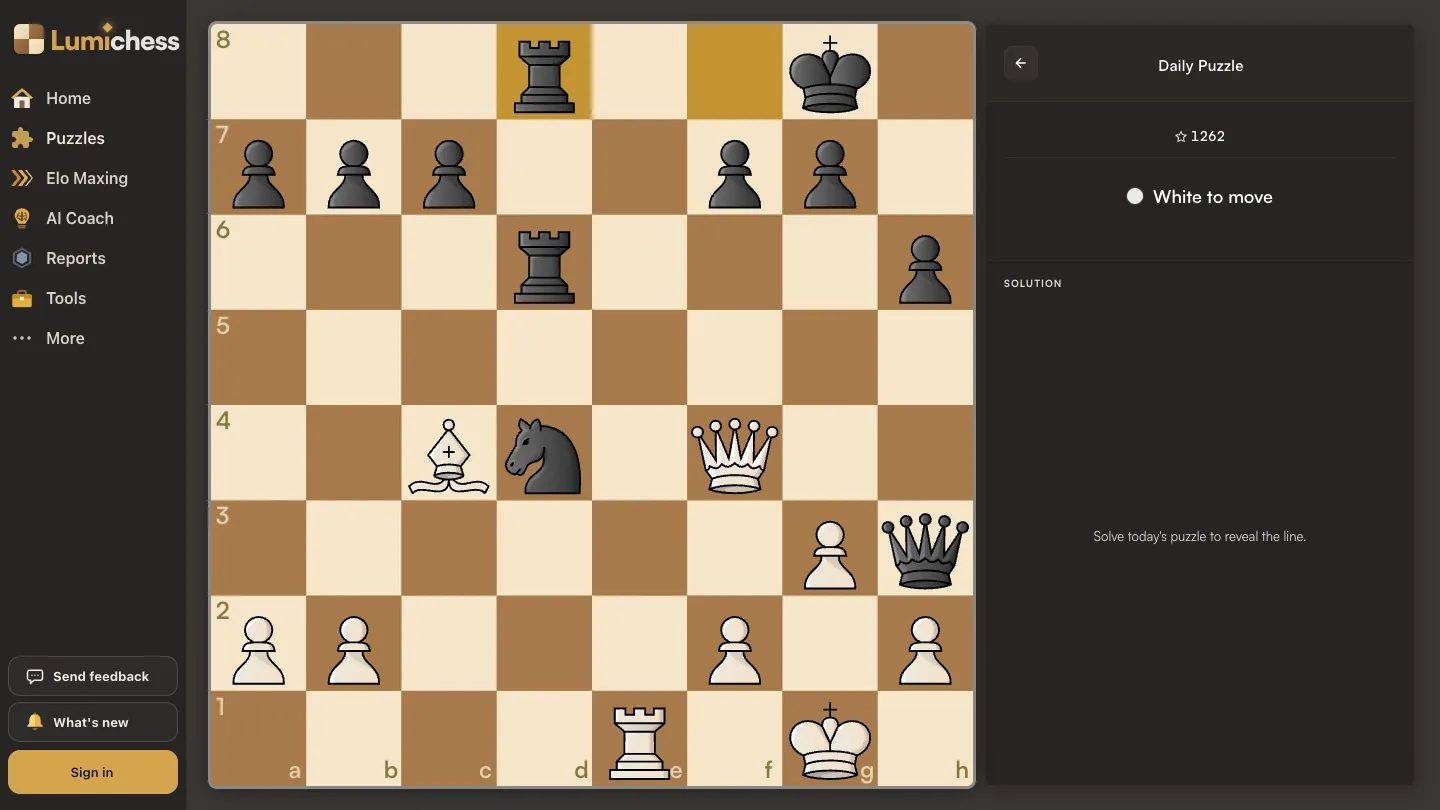
3r2k1/ppp2pp1/3r3p/8/2Bn1Q2/6Pq/PP3P1P/4R1K1 w - - 0 1
Step 1, read the position. Black's queen on h3 and knight on d4 are close to White's king, and Black's rook has just left f8, which leaves the pawn on f7 guarded only by the king. White's bishop on c4 also points at f7.
Step 3 first, in this case: Black's threat. Black is not defending here; Black is attacking. If White plays a slow move, Black's pieces are ready to crash through around the white king. According to Stockfish, if White could pass, Black would be clearly winning. So whatever White plays has to be forcing.
Step 2, the forcing moves. White's checks are 1.Qxf7+, 1.Bxf7+ and 1.Re8+. Look at each one. 1.Bxf7+ and 1.Re8+ both run out of steam: Black meets each one calmly, then its own attack comes first, and Stockfish rates both as losing for White. That leaves the queen capture.
Step 4, calculate it through. 1.Qxf7+ leaves Black two moves: 1...Kh8 or 1...Kh7. Take the main line, 1...Kh7. Now 2.Bd3+ is check along the diagonal from d3 to h7. Black can block or move the king, and the least bad of the options is 2...Qf5, putting the queen in the way. Then 3.Bxf5+ Nxf5 4.Qxf5+ and White has won Black's queen: White ends up with queen and rook against two rooks. If Black tries 1...Kh8 instead, 2.Re8+ is even stronger, and Stockfish rates it as worse for Black than the main line.
The idea in one sentence
Take on f7 with check, drive the king to h7, and the bishop check on the b1 to h7 diagonal forces Black's queen to block and be lost. Every other first move loses for White, which is exactly what makes it a puzzle.
We checked every line above with Stockfish, and you can do the same: paste the FEN into the Analysis Board and play through it. If the notation is unfamiliar, FEN chess notation explained takes the position apart field by field.
When you get it wrong
A wrong answer on a daily puzzle is more useful than a lucky right one, as long as you find out why. Almost always, the reason is one reply you did not consider: a block, an in-between check, a defender you did not count. Find that reply and name it. "I did not look at the queen block on f5" is a lesson you can carry into your next game. "I got it wrong" is not.
If the same kind of miss keeps happening, that is a pattern worth training directly. The Woodpecker Method drills one motif until it is automatic, and mistake training gives you back the positions you got wrong in your own games.
Keeping the streak
The Lumichess daily puzzle is free and needs no account. A new puzzle arrives at midnight UTC, taken from the open Lichess puzzle database of positions from real games. Solving it extends your streak, and missing a day resets it. On one device you do not need to sign in to keep a streak; signing in carries it between your phone and your computer.
A few things help the habit stick. Attach it to something you already do every day, like your first coffee. Solve it before you play any games, while your head is clear. And do not skip a day because the puzzle looks hard: a failed attempt keeps the habit alive, and the habit is the point.
When one is not enough
On days you have more time, build on it. Rated puzzle training matches puzzles to your level with no clock. Puzzle Storm trains recognition speed against a timer. And the most valuable training of all is on your own games: reviewing them shows you which tactics you actually miss when it counts.
Frequently asked questions
Where can I find a free daily chess puzzle?
On the Lumichess Daily Puzzle page. A new puzzle from a real game arrives every day at midnight UTC, and it is free with no account needed.
Is one chess puzzle a day enough to improve?
On its own it keeps your pattern recognition warm rather than transforming your rating. Its real value is as a habit that survives busy weeks. Add longer sessions when you have time.
How should I solve a chess puzzle?
Read the position first, list the checks, captures and threats, check what your opponent is threatening, calculate each candidate to the end against the best defence, and only then move.
What should I do if I get the daily puzzle wrong?
Find the reply you missed and name it. That missing reply is usually the lesson, and noticing it is worth more than a lucky correct answer.
Do I need an account to keep a streak?
No, not on a single device. Signing in carries the streak between devices.
Where do the daily puzzles come from?
From the open Lichess puzzle database, which is built from positions in real games rather than composed problems.