Ask a club player what is holding them back and you will get a confident answer. My openings. My endgames. I keep hanging pieces. Sometimes they are right. Often they are describing the last painful game, or the weakness they have heard other players complain about, rather than the thing that actually costs them rating.
The only honest way to know is to look at a batch of your own games and measure. This guide explains why one game is not enough, which skills are worth measuring, and how to read the result, using a real Profile Report of 40 games where the biggest weakness was not a chess skill at all.
The short version
- One game cannot separate a real weakness from a bad day. Forty games can.
- Measure six skills: openings, tactics, endgames, converting wins, time use and defence.
- Start with your lowest score and read only the sections under it.
- In the real report below, 19 of 23 losses were on time. The chess was mostly fine; the clock was not.
- A weakness is only useful once it becomes training. Every skill maps to something you can practise.
Why one game is not enough
Reviewing a single game is the right way to learn from that game, and the ten-minute review routine shows how. But one game cannot tell you what your weaknesses are. Everyone blunders sometimes, loses a won endgame sometimes, runs short of time sometimes. From one game, there is no way to tell a habit from an accident.
Across a batch of games, the accidents cancel out and the habits stay. If you lose on time in four of your last ten games, that is not bad luck. If your accuracy drops sharply every time the queens come off, that is an endgame problem you can name. Neither is visible one game at a time. That is why a Profile Report reads your last 40 games in one time control, not your last one.
Stick to one time control. Your bullet games and your rapid games are different sports played with the same pieces, and mixing them hides the pattern you are looking for.
The six skills worth measuring
A rating is one number, and one number cannot tell you what to work on. The Profile Report splits your play into six skills and scores each one against players at your own rating, so a score means the same thing at 800 as at 1800:
| Skill | The question it answers |
|---|---|
| Openings | How do you stand when the opening is over, by colour and by line? |
| Tactics | When a tactic is on the board, for you or against you, do you see it? |
| Endgames | How accurately do you play once material comes off? |
| Conversion | When you are winning, do you actually win? |
| Time management | Where does your clock go, and what happens to your play when it runs low? |
| Resourcefulness | When you are losing, how often do you save the game? |
Two of these are about chess knowledge, openings and endgames. Two are about calculation, tactics and conversion. And two are about practical play, the clock and defence. The last pair is the one players most often overlook, because a loss on time or a collapse in a bad position never feels like a chess problem, even when it is the most common way you lose.
A real report: the weakness that was not chess
Here is a real Profile Report of 40 bullet games from a Chess.com player rated around 800. The record was 16 wins, 23 losses and a draw, with an average accuracy of 74.1%. This is the skill profile:
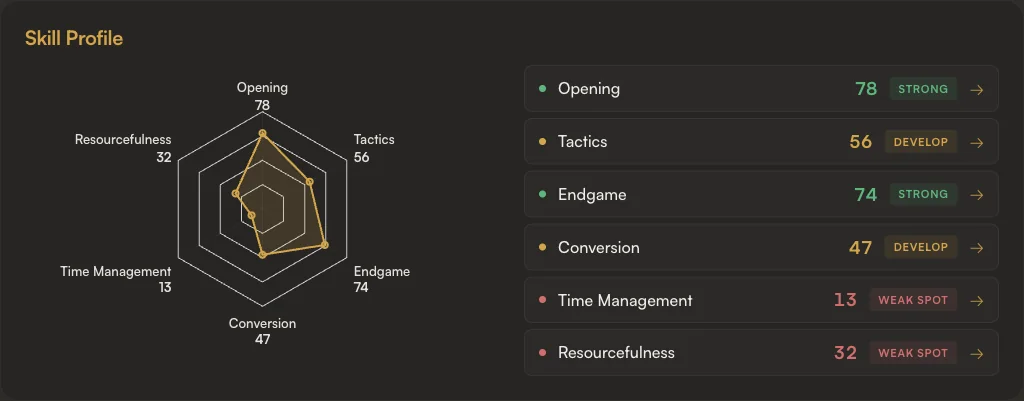
The first surprise is where the strengths are. Openings score 78 and endgames 74, both marked strong: this player comes out of the opening well and plays reasonably once material is off. If you asked them, they might well have named openings as the thing to study. The report says the opposite.
The weak spot is time management, at 13. Open that section and the reason is plain:
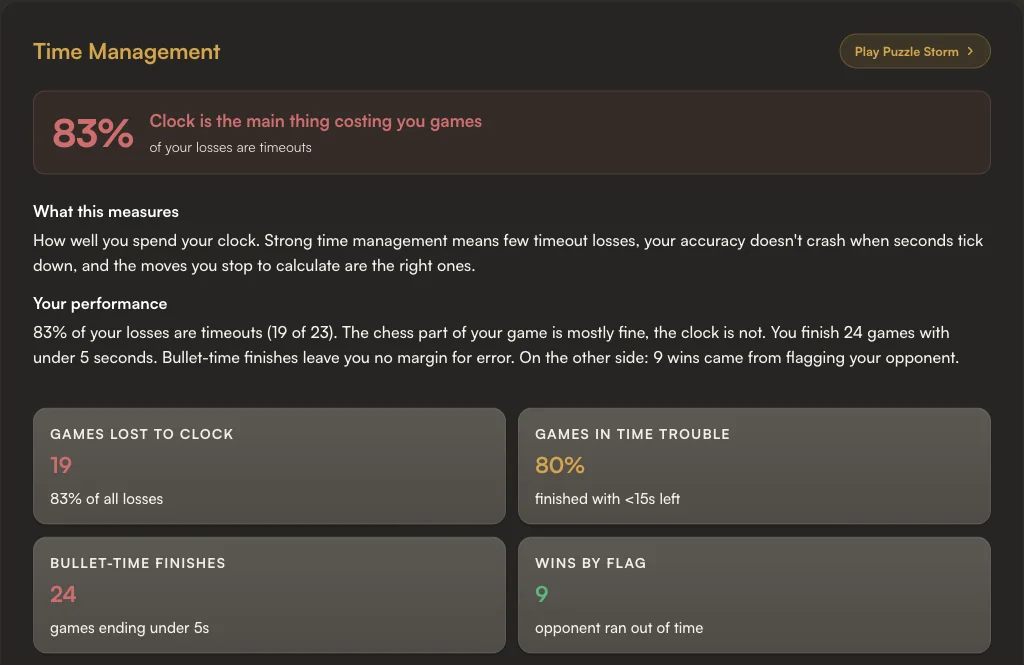
19 of the 23 losses were timeouts. Twenty-four of the 40 games ended with under five seconds on the clock, and 80% ended with under fifteen. On the other side, 9 of the 16 wins came from the opponent running out of time. This player's results are decided by the clock far more often than by the board.
That changes what to work on completely. Studying openings, the strongest skill, would change almost nothing. Playing faster in the opening and the simple positions, saving time for the moments that need it, and playing some games with increment would change a great deal. The improvement plan at the end of the report says exactly that:
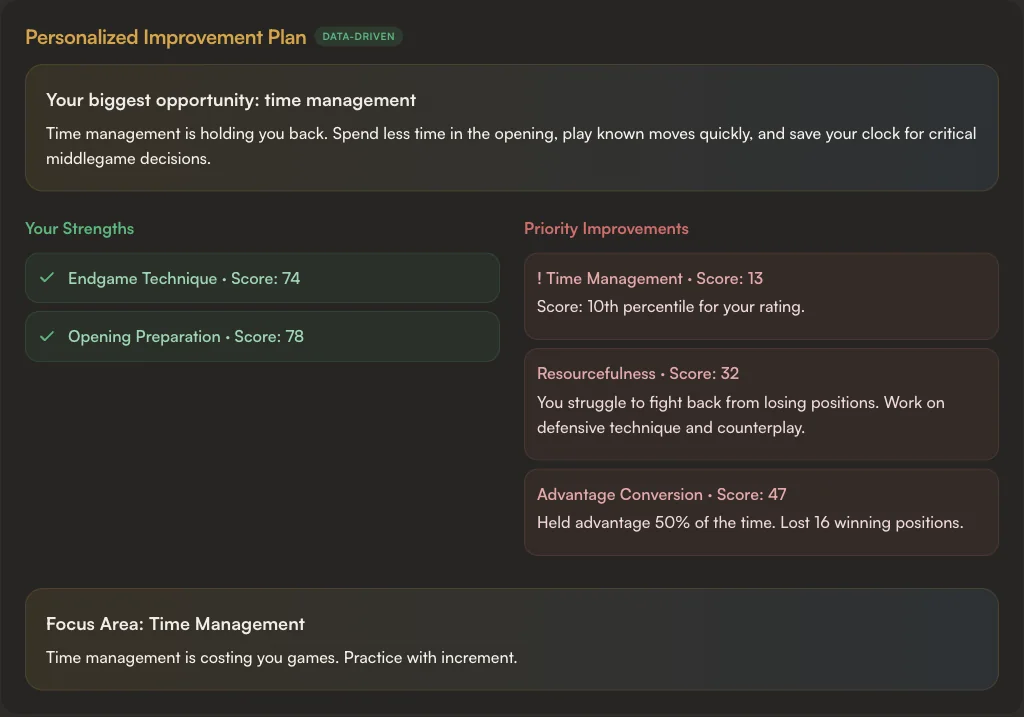
The second priority is worth a look too. Conversion scores 47, and the plan notes 16 winning positions that were not won. In bullet those two weaknesses are linked: a winning position you cannot finish before your flag falls is a loss. Fix the clock, and some of the conversion problem fixes itself.
The lesson
The weakness that costs you most is often not the one you would guess, and sometimes it is not about chess moves at all. That is the case for measuring before you train.
How to read your own report
- Find your lowest skill. That is where the most rating is waiting.
- Open that section only. Every section explains what it measures and shows the numbers behind your score. Read the three or four that matter to you rather than all of them.
- Check whether it is the format. A terrible time score in bullet may simply be bullet. If you care about rapid, run a report on your rapid games and compare.
- Look at your strengths too. They tell you what not to spend time on, which is as useful as knowing what to fix.
- Open the games behind the numbers. The report lists your three worst games and every game in the batch, each one click from a full Game Report. A number becomes useful when you have seen it happen on the board.
What else the report shows
Beyond the six skills, the report breaks your games down in the ways that most often explain a stuck rating:
| Section | What it can reveal |
|---|---|
| Rating and momentum | Where your rating has been going across the batch. |
| Performance by colour | A repertoire that only works with one colour. In the report above, 50% wins as White and 30% as Black. |
| Game phases | Whether the opening, middlegame or endgame leaks the most. |
| Accuracy by piece | The piece you handle worst. |
| Castling | When and where you castle, and what it costs when you do not. |
| How you win and how you lose | Checkmate, resignation or the clock, for your wins and your losses. |
| Mental game | How you play after a loss, and whether long sessions hurt you. The player above once played 14 games in a single day. |
Turning a weakness into training
A diagnosis only matters if it changes what you do next. Each skill points to a kind of practice:
| Weak skill | What to practise |
|---|---|
| Tactics | Puzzles, especially the patterns you miss: your own mistakes and Woodpecker theme sets. |
| Openings | Learn the ideas of the lines you actually reach, starting from the openings library. |
| Endgames | Basic endgames until they are automatic, and a review of every endgame you lose. |
| Conversion | Review won positions you did not win: simplify when ahead, and check your opponent's counterplay first. |
| Time management | Play faster in the opening and in simple positions, add increment, and do timed puzzle runs for quicker recognition. |
| Resourcefulness | Review your lost positions and look for the defensive tries you skipped. Keep playing bad positions instead of resigning early. |
Then give it time and measure again. Run a new report after a month of focused work, on the same time control, and see whether the skill you trained has moved. The AI Coach goes a step further and builds a daily session around your weakest skills, so the training follows the diagnosis without you having to plan it.
Frequently asked questions
How do I find my chess weaknesses?
Look at a batch of your own games, not one. Measure openings, tactics, endgames, converting wins, time use and defence separately, then start with the lowest. A Profile Report does this from your last 40 games.
How many games do I need to find a weakness?
Enough to separate a habit from an accident. One game cannot do it. Around 40 games in one time control gives a clear picture.
Should I mix bullet, blitz and rapid games?
No. They reward different skills, and a weakness in one, such as the clock in bullet, can look very different in another. Analyse one time control at a time.
Can I run a Profile Report on another player?
Yes. Any public Chess.com or Lichess username works, so you can study an opponent the same way you study yourself.
What if my weakest skill is time management?
Play faster in the opening and in simple positions, save time for the critical moments, and play some games with increment. In fast time controls, the clock is part of the game.
How often should I check my weaknesses?
After a month or so of focused training, on the same time control. That is long enough for a real change to show and short enough to keep your training on track.