Free, unlimited Game Reports for Chess.com Lichess.
- Play online. Live chess against real opponents.
- Track multiple profiles. Chess.com and Lichess in one place.
- Free Profile Report on your last 40 games. You get a Skill Profile, Performance Radar, opening repertoire, time-management trends, mental-game insights, and a personalized improvement plan.
Drop in your username to begin.
Choose a platform and enter your chess username.
Sample Games
Click Review to check the game report.
Your Recent Games
Analyze your chess games free, without signup and no daily limit
Lumichess provides a free chess review for Chess.com, Lichess and direct PGN games, powered by Stockfish 18. Type your username or paste a PGN and your games load straight away. No signup, no card, and no ceiling on how many games you review. You also set the engine depth yourself, from a quick pass to a deep look at the positions that decided it.
Hit a daily limit elsewhere? Most chess training platforms either cap how many games you can review or charge you for the privilege. On the Chess.com free tier that is one game analysis a day, with full engine review reserved for Diamond membership. Lumichess reviews every game in your history with full Stockfish analysis, free, in bullet, blitz, rapid or classical, with no restriction on time control or on how many games you run. See how Lumichess compares with Chess.com and Lichess.
Free chess game review with move-by-move analysis
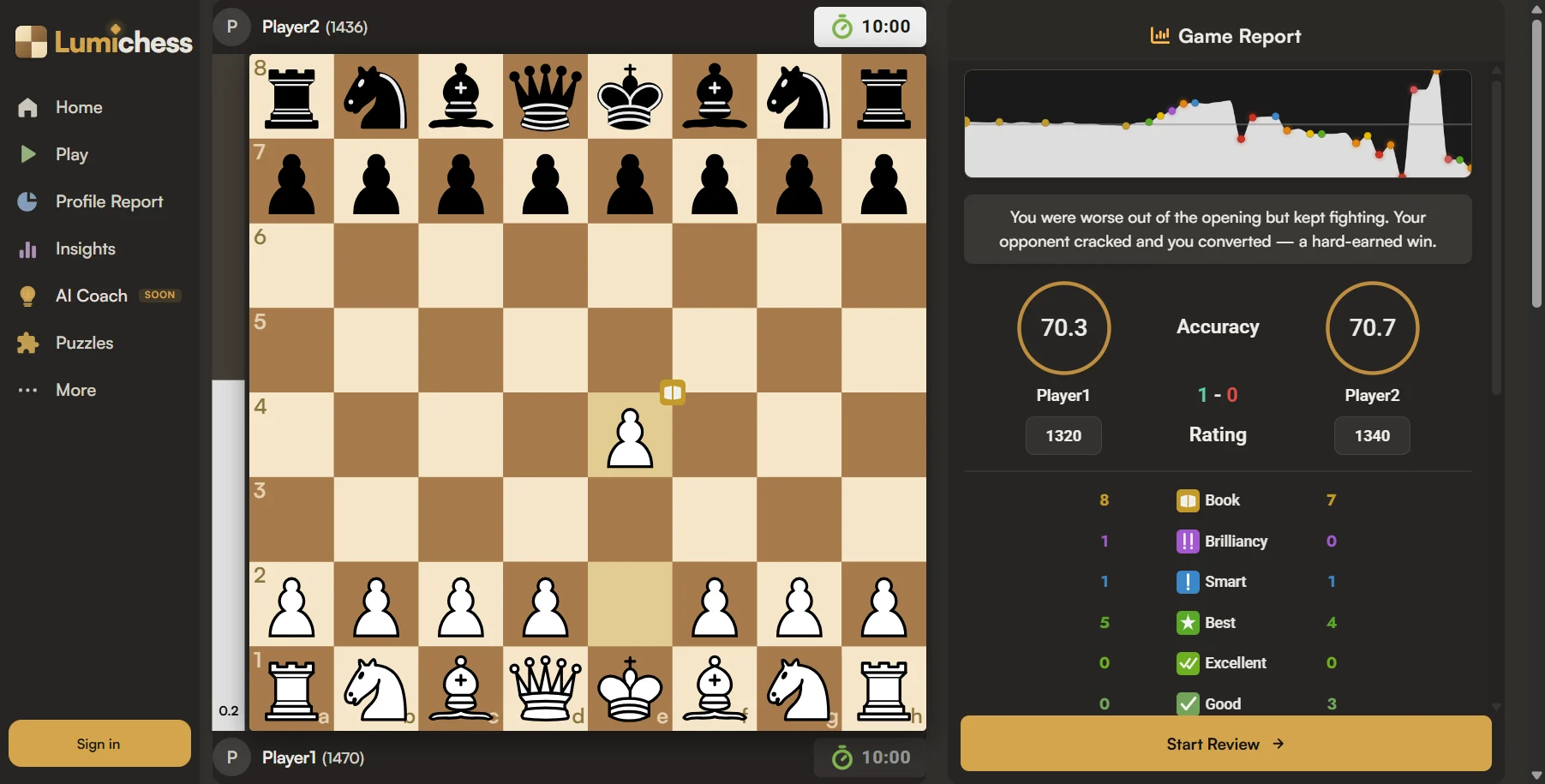
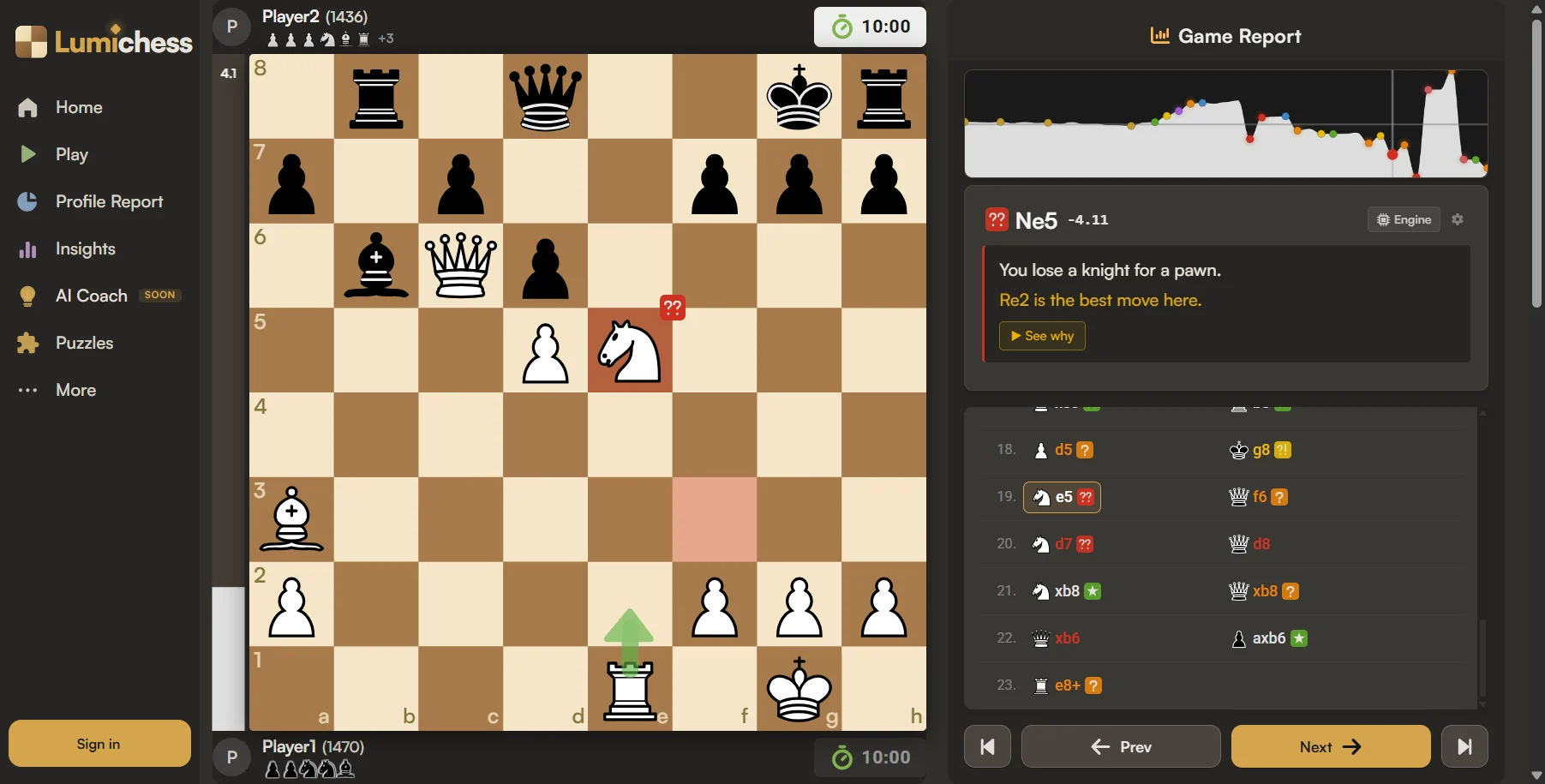
Game Report takes a single game from Chess.com, Lichess or a PGN you paste, and runs Stockfish over every position in it at the depth you choose, from 10 up to 30. Each position is searched for several candidate moves rather than one, so the report knows the second and third best replies as well as the first, and can tell a move that was genuinely forced from a choice you got wrong.
What comes back is a reading of the whole game. Accuracy for both players, scored on win probability rather than raw centipawns, so a slip in a dead-drawn position is not punished like a blunder in a sharp one. The same accuracy split across opening, middlegame and endgame, which is usually enough on its own to show you which phase is costing you rating. An evaluation graph of the full game with every move marked on it, so the moment it turned is visible before you read a word. A count of all eleven move classifications for both sides. And a written summary that says in ordinary language how the game was actually won or lost.
Your move lands in one of those eleven outcomes, from Brilliancy down to Blunder, with Book for theory and Forced where there was no choice. Every label is defined in the chess terms glossary.
Works with Chess.com, Lichess and PGN
Type a Chess.com or Lichess username and your recent games load automatically. Games loaded as PGN work too: paste the text or upload the file. No signup is needed to analyze.
Chess.com gives free accounts one game review a day and puts full engine analysis behind Diamond membership. Lumichess has no daily limit and no premium tier on analysis. Bullet through classical, as many games as you want. See the full comparison with Chess.com and Lichess.
The Lumichess Profile Report: your last 40 games
A single loss proves little. The Lumichess Profile Report reads your last forty games and resolves them into six measured skills: openings, tactics, endgames, conversion, time and resourcefulness, each scored against players in your own rating band.
It shows which openings earn their place and which leak rating, where your clock and accuracy diverge, and how many winning positions you convert.


Free chess stats and Insights for Chess.com and Lichess
Lumichess Insights reads your whole history rather than your last few games, across up to four Chess.com and Lichess handles, together or one at a time. It opens on Overview: your rating in every time control with the change over your last thirty games, how your games divide between bullet, blitz, rapid and classical, your record as White against Black, and the ways your wins and losses actually arrive.
Openings audits your repertoire from both sides, ranking what you play by how often it appears and how well it scores, and plots your games across the ECO map so you can see the ground you never visit. Opponents breaks your results down by the strength of who you faced, which is where an inflated record against weaker players stops hiding. Patterns covers when you play and how games end: a twelve-month activity heatmap, win rate by hour of day and by day of the week, and whether your wins come by checkmate, resignation or the clock, with your losses read the same way. That is the tab where tilt shows up before it costs you Elo.
Games is your full searchable history, one click from a report on any of them. And FIDE steps outside the online world: official ratings and rating-list history for any registered player, an estimate of your own FIDE strength from your online results, and a head-to-head between any two rated careers.
Compare your chess stats with any player
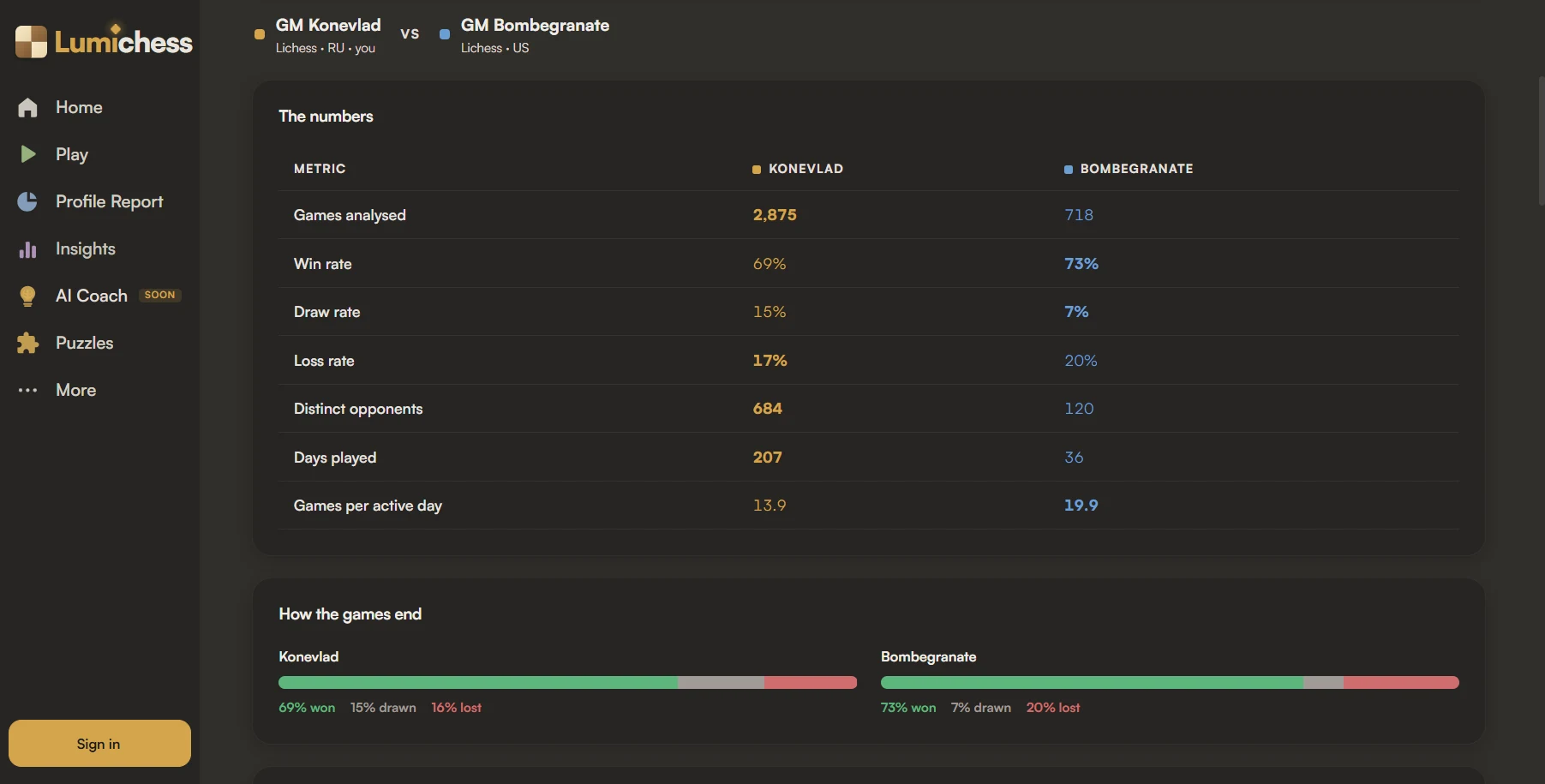
Settle it with numbers. Sign in, type any Chess.com or Lichess username, and the Compare tab reads their public games exactly the way it reads yours, then puts the two careers in one table: games played, win rate, draw rate, loss rate, distinct opponents, days played and games per active day, with the stronger number marked on every row.
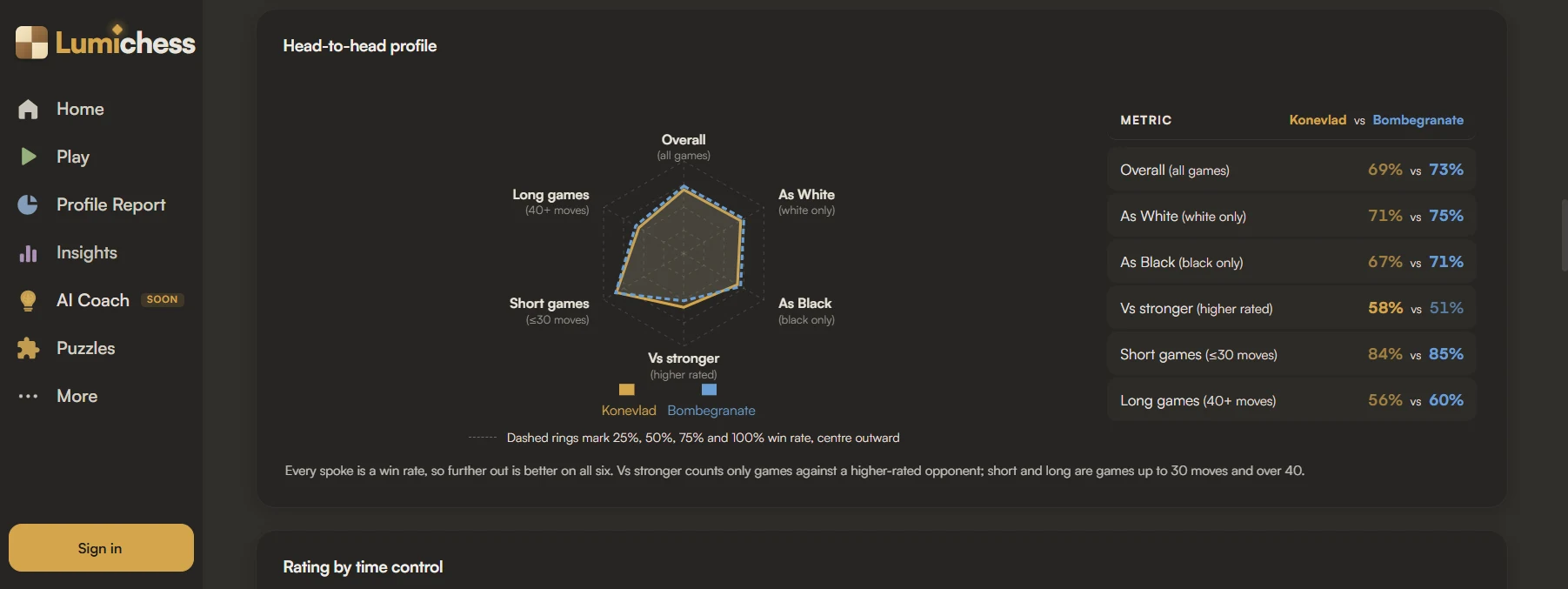
Then it gets specific. Wins as White and wins as Black, each with the raw count, and the gap between them, because a big gap usually means a repertoire that only works on one side. A six-spoke profile puts both of you on one shape, scoring overall win rate, White, Black, results against higher-rated opponents, and how each of you does in short games against long ones.
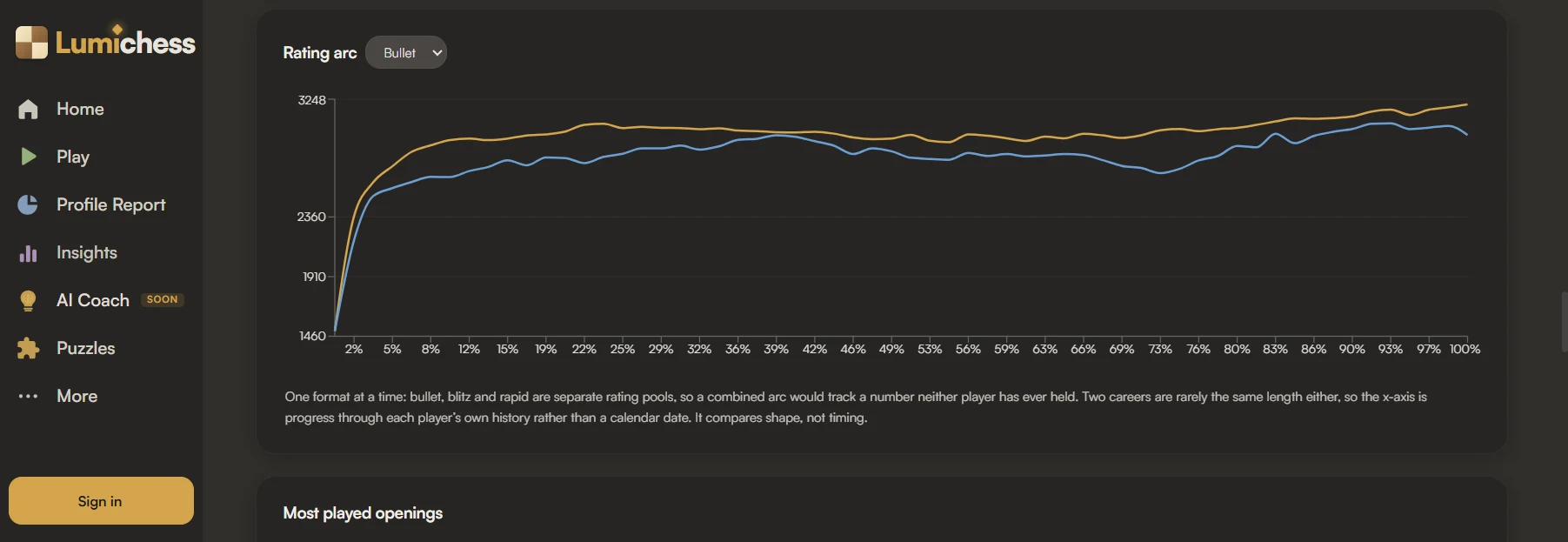
Under that, both rating arcs are drawn on a single chart, results are split side by side, ratings break out per time control, and you get the openings each of you plays most. It reaches across platforms too, so your Chess.com record can sit against their Lichess one. Free, and all it costs is a sign-in.
Free chess puzzles and the Woodpecker Method
Lumichess puzzles hold more than five million rated positions across fifteen rating bands, with a daily puzzle, adaptive training on a Glicko-2 rating, and Puzzle Storm when you want three minutes of pressure.
The Woodpecker trainer works on the opposite principle: one set built from the motifs you keep missing, frozen permanently, solved seven times and quicker each pass. It sits under your puzzle rating on purpose, because recognizing a fork beats calculating one, and that comes from repetition.


Elo maxing: find the tactic that is costing you rating Coming soon
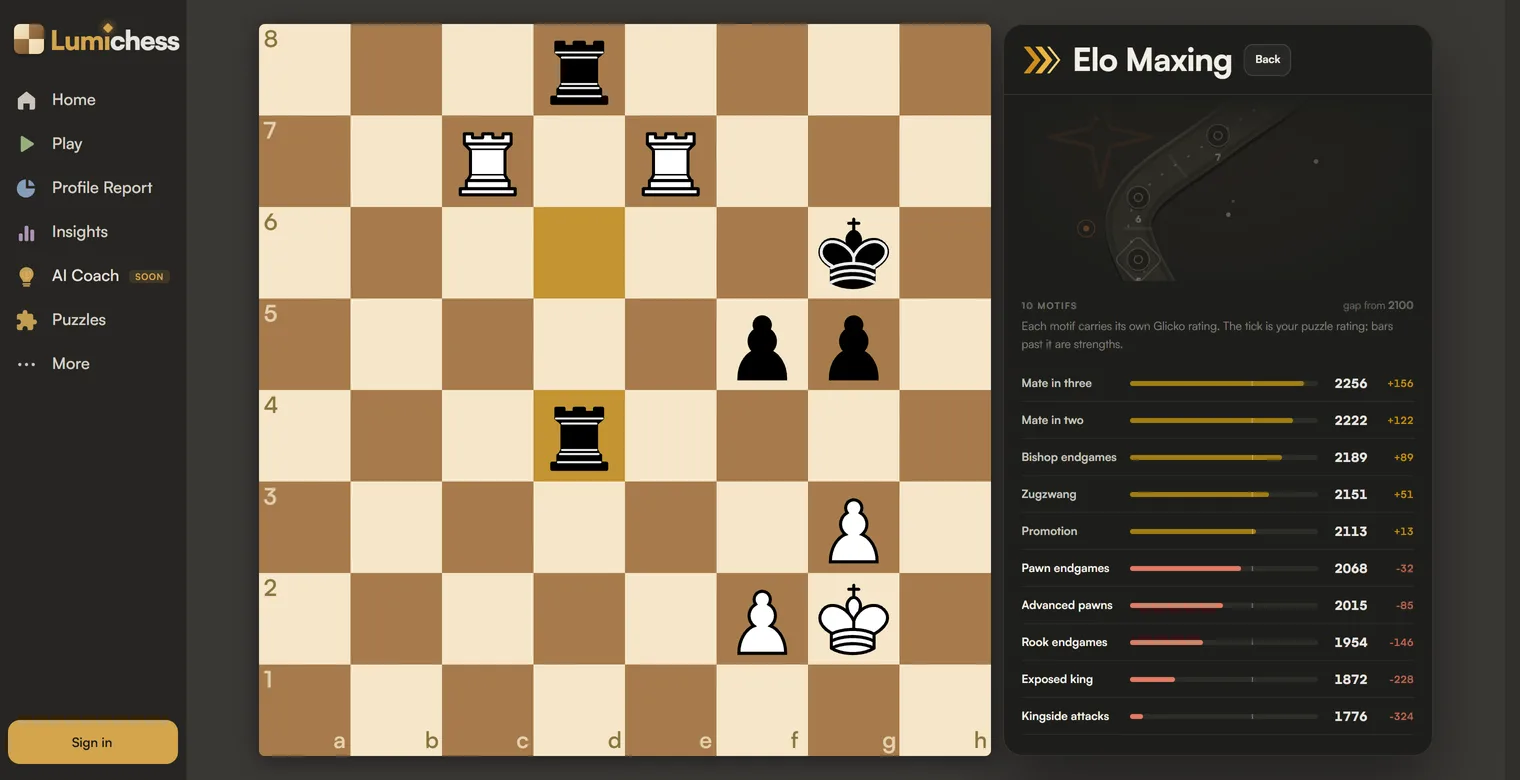
Your puzzle rating is one number hiding twenty-six. You are not “1500 at tactics”. You are 1900 at pins and 1350 at deflection, and the deflection is what loses you games. Chess.com gives you a rating. Lichess gives you a rating. Neither says which pattern is the leak.
Elo Maxing is being built to close that loop. Every solve will move one motif’s own EloElo is the rating scale chess uses to measure strength. Named after Arpad Elo, it moves on expectation rather than on wins alone: beat someone rated well above you and it climbs sharply, lose to someone below and it drops. Chess.com and Lichess ratings are Elo-style, and so are the puzzle ratings here., twenty-six of them, forks through zugzwang, each seeded at your puzzle rating and held provisional until you have attempted it three times. The next puzzle will come from your weakest motifs, in sessions of ten, and the medal at the end is scored on clean solves rather than rating gained. Raise the motif that is furthest behind and the rating it was holding down comes with it.
Play online, then review instantly
Lumichess runs live games through the Lichess Board API on a board stripped of distraction. They save to your Lichess profile like any other game. The one you just finished is a single click from a full report, which is the whole loop: play, find the move that cost you, drill the pattern behind it, play again.
Chess openings, family by family
Every opening the report names has its own page: the main variations, the ECO codes they sit under, and the positions we hold for each. Start with the Sicilian Defense, French Defense, Caro-Kann Defense or Ruy López for 1.e4, or the Queen’s Gambit Declined, London System, King’s Indian Defense and Nimzo-Indian Defense for 1.d4.
There are 62 opening families in the index, each built from our cataloged position set.
Everything above is free, and a coach is coming
The Game Report, the Profile Report, Insights and every puzzle mode are free and unmetered. But every tool above diagnoses. None treats. That is the gap Coach Lumi is being built to close: rank your leaks by the rating each costs, then build a fifteen-minute session around the most expensive, starting with your own blunders worst first, tactics on the motifs you miss, endings you score badly in, and won positions you must finish against a bot.
And it audits itself: one leak, one metric, no claim of progress until twenty rated games have gone by, and movement under three percentile points reported as noise. If the leak has not closed, it says so.
Want to become a Chess Pro? Coach Lumi is on the way. Here is what he will do.
Meet Coach Lumi
He will read every game you have played, rank what is costing you the most rating, and turn it into a 15-minute daily session built from your own positions.
- Personalised training plan. Six skills scored against your rating; the two weakest lead the session.
- Mistake analysis. Your own blunders, grouped by the pattern behind them and replayed worst first.
- Training record. Your first-try rate per module: solved with no wrong move and no hint.
- Improvement, measured. One metric per cycle, re-checked after 20 rated games. Never predicted.

Frequently Asked Questions
Is Lumichess free to use?
The Game Report, Profile Report, Insights and the puzzle trainers are free, with no quota and no card. You can analyze without signing up at all: enter a Chess.com or Lichess handle and the games arrive. Signing in only carries your streak, puzzle rating and training history between devices. Coach Lumi, the training half of the product, is in development and will be a paid tier when it arrives.
Why is there no daily analysis limit?
Because we do not meter it. Analysis runs on Stockfish 18, and every report is free however many you run. Other platforms ration game reviews and put full engine analysis behind a subscription; Lumichess does not.
How deep does the engine search?
The Game Report runs at depth 12 by default and can be set from 10 to 30 in Settings; the Profile Report defaults to depth 10, goes up to 20, or drops to Instant for a fast sweep of forty games. Every position is searched with multiple principal variations, so the report knows the runner-up moves as well as the best one.
What do the move labels mean?
Eleven outcomes, from Brilliancy and Great through Best, Excellent, Good and Book, down to Inaccuracy, Mistake, Missed and Blunder, plus Forced where only one legal move exists. A label reflects how much the position’s win probability moved when you played, so the same evaluation drop is judged differently in a sharp middlegame than in a dead endgame.
How is the accuracy percentage calculated?
Each evaluation is converted to a win probability first, then your loss is scored against that curve and averaged across the game. Scoring the probability rather than the raw centipawn number is what stops a technically large but practically meaningless slip in a won position from wrecking your score.
What is the Woodpecker Method?
A fixed set of tactical positions, drawn from the motifs you personally miss, that is built once and then never altered. You solve the same set seven times, faster on each pass. It is pitched a little below your puzzle rating on purpose: the aim is instant recognition, not a stretch you have to calculate.
Can I compare my chess stats with another player?
Yes. The Compare tab in Insights takes any Chess.com or Lichess username and reads that player's public games the same way it reads yours, then sets the two careers side by side: games played, win, draw and loss rates, distinct opponents and days played; wins as White and as Black; a six-spoke profile covering results against stronger opponents and in short against long games; both rating arcs on one chart; ratings per time control; and the openings each of you plays most. It works across platforms, so your Chess.com record can sit against their Lichess one. It is free and needs only a sign-in.
How do I analyze a chess game for free?
Three steps, no signup. Choose Chess.com or Lichess and type your username, or paste the PGN if the game was played somewhere else. Pick the game you want from the list that loads. The report grades every move from Brilliancy to Blunder, scores accuracy for both sides, and draws the evaluation graph so you can see the move the game turned on. There is no cap on how many you run.
Do you need my Chess.com or Lichess password?
No, and you should never give it to us or to anyone else. A public username is all Lumichess needs, which is why analysis works without an account at all. Playing live games goes through the Lichess authorization screen, where you approve access on Lichess itself and no password reaches us.
Does Lumichess work on a phone?
Yes. The site runs in a mobile browser, installs as an app from it, and there are native iOS and Android builds. Analysis is heavier work on a phone than a laptop, so a forty-game Profile Report takes longer; dropping the depth or using the Instant sweep keeps it quick.
Can I review an over-the-board or tournament game?
Yes, through PGN. Most tournament software, DGT boards and scoresheet apps export one. Open the PGN option under the username field, paste the text or upload the file, and the game gets the same report as an online one. No signup or username needed.
Can I track Chess.com and Lichess together?
Yes. Connect up to four handles across both sites and Insights will chart them combined or one at a time, with a FIDE tab for official ratings, a rating estimate from your online results, and a head-to-head comparison of any two FIDE players.