Most players who train tactics hit the same wall. They solve puzzles every day for months, their puzzle rating climbs for a while, and then it stops. The puzzles have not got easier. The problem is that a random stream of puzzles spends most of its time on patterns you already know, and very little on the ones you keep missing.
Elo Maxing is built around the opposite idea. Instead of one puzzle rating, you get a rating for every tactical motif, and each session is aimed at the motifs you are weakest at. This guide explains how it works, walks through a real puzzle from a session, and shows where it fits alongside other puzzle training.
The short version
- A single puzzle rating hides which patterns you are good and bad at.
- Elo Maxing keeps a separate rating for every motif, from forks and pins to deflections and back-rank mates, plus how far ahead you can calculate.
- A session is ten puzzles, each taken from a motif you are weak at right now.
- You get one attempt per puzzle, and a medal for how many you solve cleanly.
- Every finished session moves you one level along a road of 64 levels in eight tiers.
Why random puzzles plateau
A random puzzle set is drawn from millions of positions, so it trains patterns in proportion to how often they appear in chess overall. That is a fine default when you are starting out. Later, it becomes a waste of time. If you already see every knight fork and keep missing deflections, a random set still gives you mostly forks.
Your single puzzle rating makes this worse, because it averages everything together. A player who is excellent at forks and weak at back-rank mates can have the same rating as one who is average at both, and neither of them learns from the number where their time should go.
A rating for every motif
Elo Maxing splits tactics into motifs: forks, pins, skewers, discovered attacks, deflections, back-rank mates, promotions, endgame technique and many more. Each one carries its own rating, and every puzzle you solve moves the rating of the motif it belongs to, not only your overall number.
Alongside the motifs there are calculation tracks, for one-move, short, long and deep combinations. A motif asks whether you know the pattern. A calculation track asks how many moves ahead you can still hold it. Being strong at forks but weak at deep combinations says something no single rating can: you know the pattern, and you lose it when the line gets long.
All of these ratings together make up your skill graph. A new rating is shown with a question mark while it is still settling, and the mark comes off as you attempt that motif more. Your overall puzzle rating is the same one used by Puzzle Training and the daily puzzle, so it moves the same way wherever you solve.
A session, puzzle by puzzle
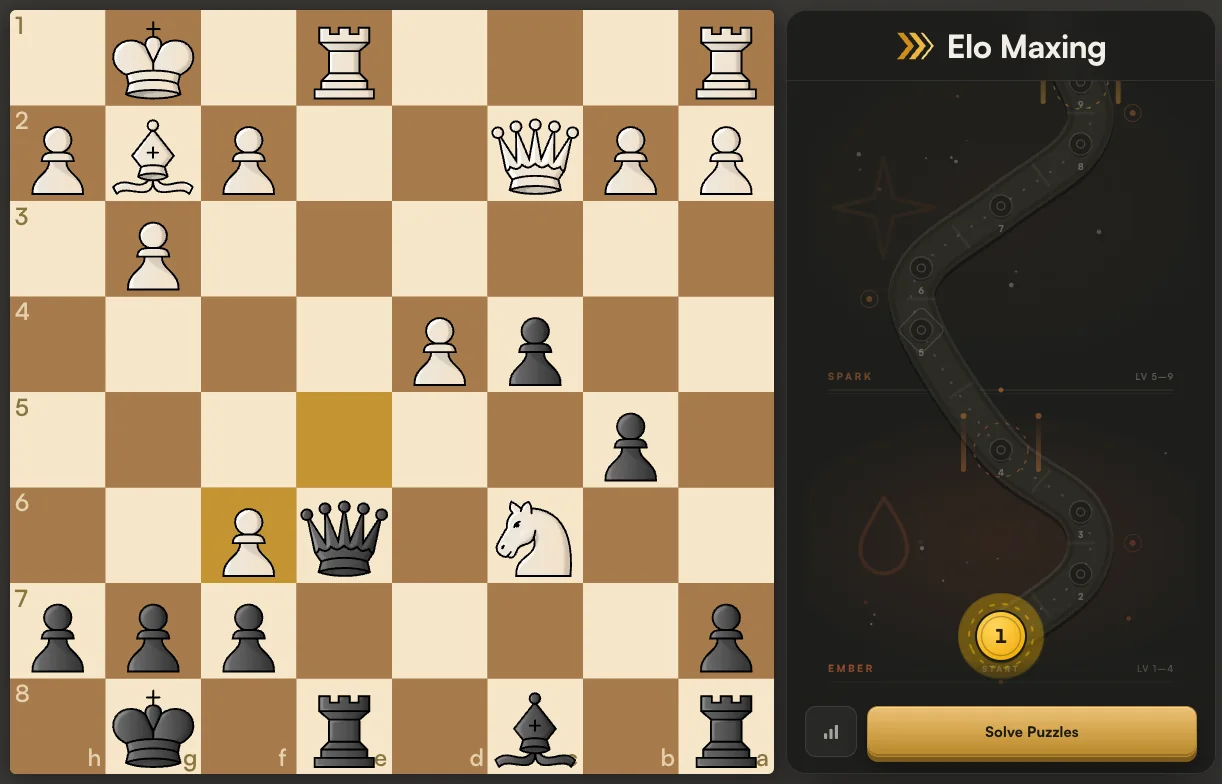
A session is ten puzzles. As the coach puts it at the start: each one comes from the motif you are weakest at right now. Early on, Elo Maxing works through the motifs to measure each of them. After that, most of your puzzles come from your weakest motifs, and the rest keep every other rating current, so a motif you have improved does not go stale.
Each puzzle gives you one attempt. A wrong move ends it: the answer is played out on the board and the next position loads. There is no second try and no escalating hint, because the first mistake has already told the skill graph what it needs to know, and dwelling on a lost puzzle only costs you the session.
Ten is a deliberate number. Enough to make real progress in one sitting, short enough to keep your attention sharp. Pattern recognition degrades as you tire, so twenty careful puzzles beat a hundred rushed ones.
A real puzzle from a session
Here is the first puzzle from a session on a new account, with the puzzle rating still at a provisional 1,500. Black has just moved the queen from e7 to f6, and it is White to move:
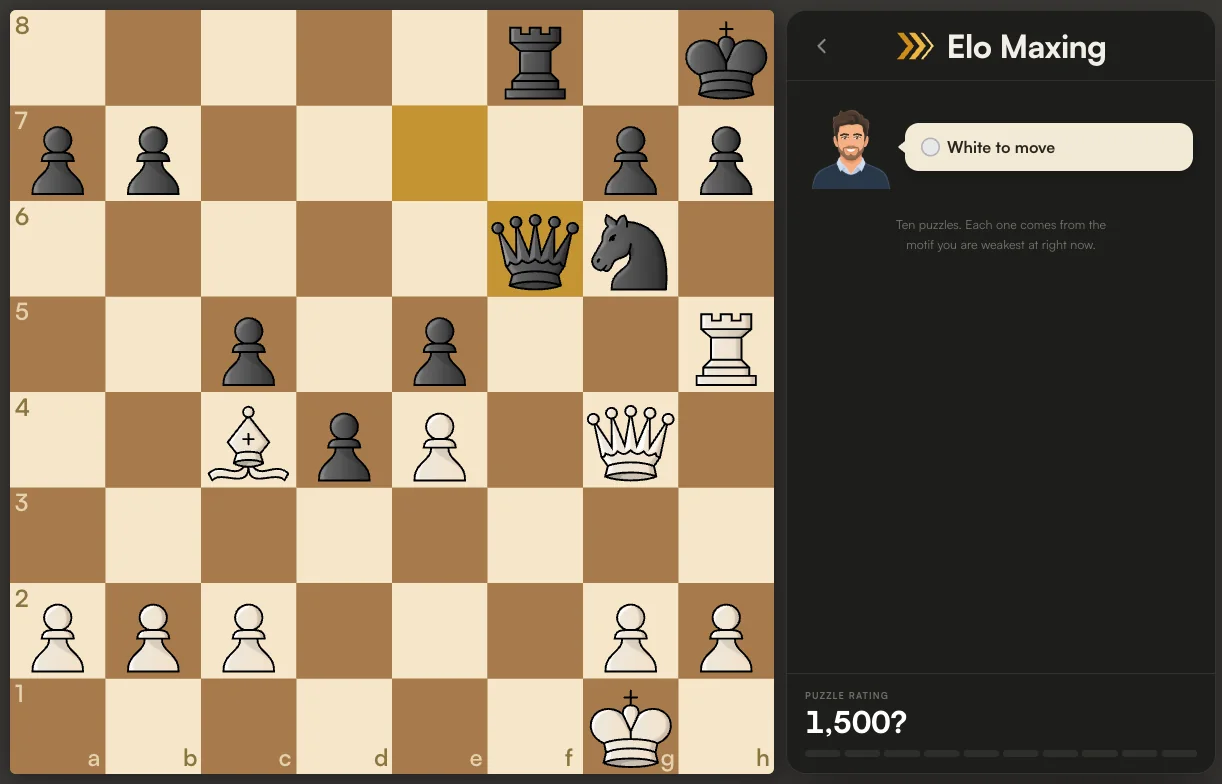
Start with checks. 1.Rxh7+ gives up the rook, but Black has only one reply: the king cannot step to g8, because the bishop on c4 covers it along the diagonal, so it must take, 1...Kxh7. Now 2.Qh5# is checkmate. The queen checks down the h-file, g8 is still covered by the bishop, g7 and g6 are blocked by Black's own pieces, h8 is on the same file, and nothing can interpose on h6.
It is a classic pattern: a sacrifice that drags the king into the open, then mate on a file the defender cannot close. We checked it with Stockfish, which finds the same mate in two. If you missed it, that is exactly the information Elo Maxing uses: the motif behind this puzzle would drop, and more like it would come your way until you see them on sight.
Clean solves, medals and the road
At the end of a session you earn a medal, gold or silver, based on how many puzzles you solved cleanly: first move right, no hint. Clean solves are the fair measure, because the difficulty is already matched to you, and a clean solve is the one that shows you recognised the pattern rather than worked it out by trial.
Every finished session also moves you one level along the road. There are 64 levels in eight tiers, Ember, Spark, Flare, Lantern, Beacon, Halo, Aurora and Zenith, and the tiers get longer as you climb. Past the summit the road starts again, one cycle higher.
Why one attempt matters
In a real game you get one move. Training with one attempt per puzzle builds the habit of checking before you commit, which is the habit that stops you blundering when it counts.
Where it fits with other puzzle training
| Training | What decides the puzzle | Best for |
|---|---|---|
| Elo Maxing | Your weakest motifs right now | Closing specific gaps in your tactics |
| Puzzle Training | Your overall rating | Broad practice at your level |
| Woodpecker | A fixed set you repeat | Making a chosen set of patterns automatic |
| Puzzle Storm | A timer and rising difficulty | Recognition speed under pressure |
| Mistake training | Positions from your own games | The exact positions you got wrong |
A good week uses more than one. Elo Maxing to aim at your weakest motifs, your own mistakes to fix what went wrong in real games, and a few timed runs to keep your recognition fast. If you want the whole plan built for you from your games, the AI Coach does exactly that.
Frequently asked questions
What is Elo Maxing?
A tactics trainer that keeps a separate rating for every motif, such as forks, pins and back-rank mates, and builds each ten-puzzle session from the motifs you are weakest at.
How is it different from normal puzzle training?
Normal puzzle training serves puzzles at your overall rating, whatever the motif. Elo Maxing measures each motif separately and uses those ratings to decide what you practise next.
How many puzzles are in a session?
Ten. You can leave part-way and your solves are kept; the medal is awarded once all ten are done.
Why do I only get one attempt per puzzle?
Because the first move is what shows whether you recognised the pattern. A wrong move plays out the answer and moves you to the next puzzle.
What does the question mark next to a rating mean?
That the rating is still provisional. It comes off once you have attempted that motif enough for the number to settle.
Does Elo Maxing use my Chess.com or Lichess rating?
No. It uses your Lumichess puzzle rating, the same one used by Puzzle Training and the daily puzzle.