Every chess player has stared at a position and wondered what the best move is. During a game you have to work it out yourself. After the game, an engine can tell you in seconds. Both are worth knowing how to do well, and they are more connected than they look: the engine is most useful when it checks a routine you already follow.
This guide covers both. First, a thinking routine for finding strong moves at the board. Then, how to read an engine's answer when you check a position afterwards. Both are tested on one real position, from one of the most famous games ever played, where the obvious move is not the best one.
The short version
- Start every move with checks, captures and threats, for both sides.
- Ask what your opponent's last move wants before you think about your own plan.
- Pick two or three candidate moves and compare them, instead of falling in love with the first.
- Before you move, blunder-check: what is your opponent's best reply?
- When you check with an engine afterwards, look at the gap between its first and second choice. It tells you whether there was one move to find or several.
The test position
Byrne against Fischer, New York 1956. Fischer, playing Black, has just played 17...Be6, leaving his queen on b6 attacked by White's bishop on c5. It is White to move:
r3r1k1/pp3pbp/1qp1b1p1/2B5/2BP4/Q1n2N2/P4PPP/3R1K1R w - - 4 18
You can paste that into the Position Editor or any analysis board to see it. (If FEN is new to you, FEN chess notation explained takes it apart field by field.) Try to find White's best move yourself before reading on.
Step 1: checks, captures and threats
The most reliable habit in practical chess is to look at forcing moves first: every check, every capture and every direct threat. Forcing moves limit your opponent's replies, so they are the moves you can calculate with some certainty, and they are where most games are decided. Do it for your own moves, then for your opponent's.
In the test position, White has no checks. White has four captures: 18.Bxb6 taking the queen, 18.Qxc3 taking the knight, 18.Bxe6 taking the bishop, and 18.Qxa7 taking a pawn. The queen is worth the most, so 18.Bxb6 is the move almost everyone looks at first. It is what Byrne played.
Step 2: what does your opponent want?
Before you choose, ask what your opponent's pieces are doing. Here the answer is alarming. Black's bishop on e6 attacks the bishop on c4, and taking it would come with check, because the white king is on f1. The knight on c3 attacks the rook on d1 and eyes e2, a square from which it would check a king on g1. White's king has no safe home.
That is exactly what happened in the game. After 18.Bxb6 Bxc4+ 19.Kg1 Ne2+ 20.Kf1 Nxd4+ 21.Kg1 Ne2+ 22.Kf1 Nc3+ 23.Kg1 axb6, Black's knight checked its way back and forth, collecting material each time, and White was lost. Taking the queen was the natural move, and it was the wrong one, because it ignored what Black's other pieces wanted.
Step 3: candidate moves
Strong players do not calculate every move. They pick a handful of candidate moves, usually two or three, and compare them. Alexander Kotov made the idea famous in Think Like a Grandmaster: name your candidates first, then analyse each one, rather than wandering from line to line.
Good candidates come from steps one and two. Here that means 18.Bxb6, the greedy capture, and 18.Qxc3, which removes the knight that does all the damage. Compare them honestly and 18.Qxc3 stands out: without the knight, Black's windmill does not exist.
Step 4: the blunder check
Before you touch a piece, look at the position after your move from your opponent's side. What is their best reply? Is anything of yours left undefended? Is there a check you have missed? This takes ten seconds and saves more games than any opening you will ever learn.
Run the blunder check on 18.Bxb6 and the danger shows up at once: 18...Bxc4+ is check. A check against your own king, with your king short of squares, is enough reason to look for something else before you have seen the whole windmill.
The routine in one line
Checks, captures and threats for both sides. What does their last move want? Two or three candidates. Their best reply to mine. Then move.
When there is no tactic
Many positions have no forcing move worth making. Then the best move is usually a quiet improvement, and a few questions will find it:
- Which of my pieces is worst? A bishop blocked by its own pawns, a knight on the rim, a rook with no open file. Improve it.
- Where is my king safest, and is it there yet?
- Which pawn break opens the position in my favour, and is it ready?
- What would I like to do next move, and what does this move need to prepare it?
Quiet moves are harder to check with calculation alone, which is one reason reviewing your games afterwards matters so much. The ten-minute review routine shows how to find the moments where your plan went wrong.
Checking with an engine
After the game, an engine will tell you the best move in any position. Stockfish is far stronger than any human, so its answer is the standard to compare yourself against. Paste the position into the Best Move Finder as a FEN, or paste a whole game as a PGN and it answers for the final position.
Here is what it says about the test position:
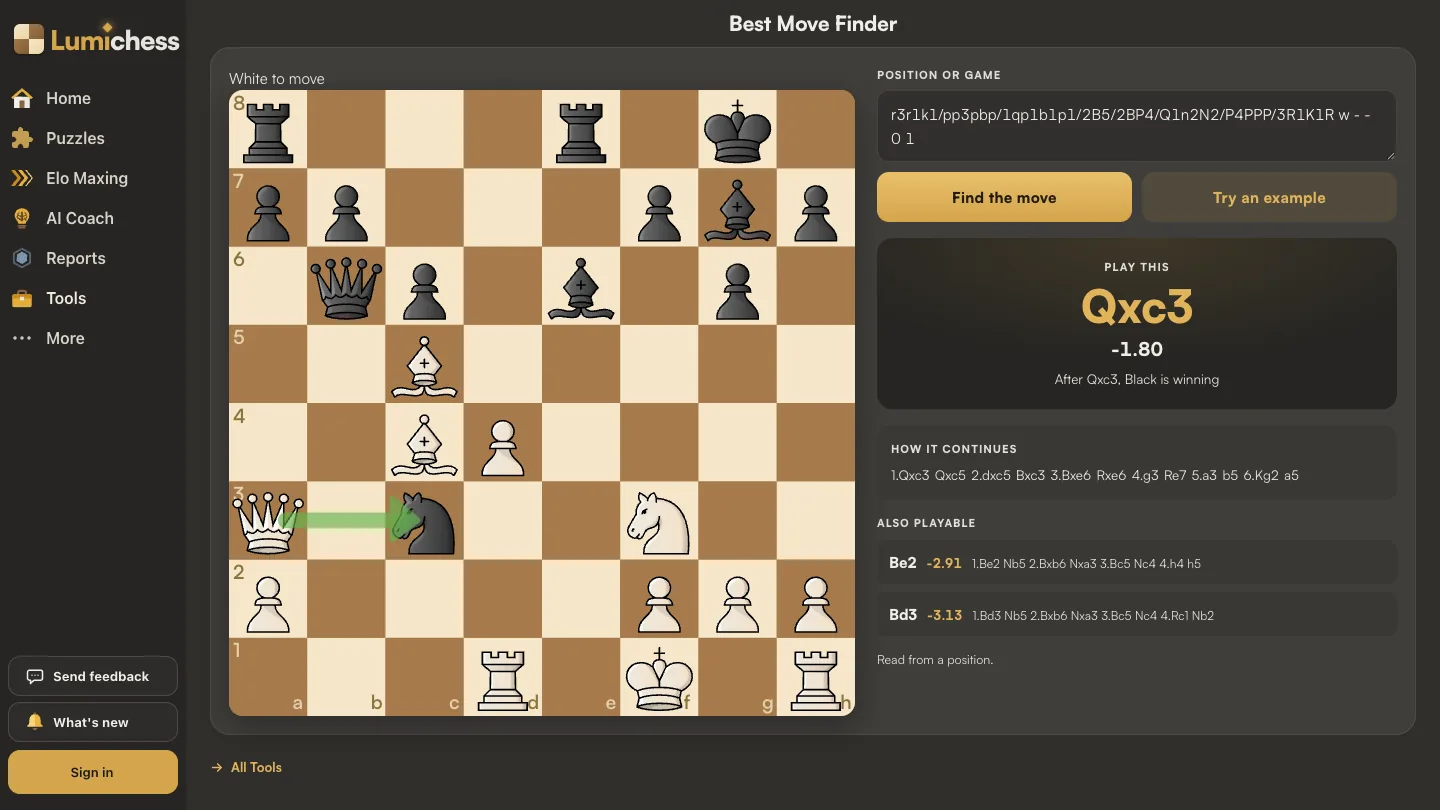
Stockfish 18 picks 18.Qxc3, evaluated at -1.80: Black is still better, but White is fighting. Its expected line is 18.Qxc3 Qxc5 19.dxc5 Bxc3 20.Bxe6 Rxe6, which trades off the queens and leaves White a pawn down in an endgame with rooks, knight against bishop. The next choices are 18.Be2 at -2.91 and 18.Bd3 at -3.13. The move Byrne played, 18.Bxb6, is worse than all three: the Game Report for the game puts it at -3.92.
Reading the engine's answer
An engine's answer is more than the top move. Four things are worth reading:
| Part of the answer | What it tells you | In the test position |
|---|---|---|
| The best move | What the engine would play. | 18.Qxc3 |
| The evaluation | Who is better, in pawns, from White's side. Minus means Black. | -1.80: Black better |
| The continuation | The line the engine expects, so you can see why the move works. | Queens come off; White is a pawn down |
| The other choices | How close the alternatives are. | Next best is more than a pawn worse |
The last row is the one most people skip, and it is often the most useful. When the second and third moves score almost the same as the first, the position had several good answers, and missing the top one cost you little. When they fall well short, as here, where the next best move is more than a pawn worse, there was one move to find. Those are the positions worth studying.
Read the continuation too, not just the move. A best move you cannot explain teaches you nothing. Step through the line on the Analysis Board until you can say in one sentence why it works. Here the sentence is short: take the knight, because the knight is what makes all of Black's checks possible.
Finally, how deep the engine looks depends on your device and on how long it thinks. For a sharp position you want to trust completely, give it longer on the Analysis Board. How to read a chess engine evaluation goes further into what the numbers mean, mate scores included.
After the game, never during it
Using an engine while a game is being played is cheating, and it breaks the fair play rules of every chess site. Engine tools are for positions from finished games, puzzle books and study. Used that way, they are one of the best teachers you will ever have. The habit that actually wins games is the routine at the top of this page, and the engine is there to show you where it let you down.
Frequently asked questions
How do I find the best move in chess?
Look at checks, captures and threats for both sides, ask what your opponent's last move wants, pick two or three candidate moves and compare them, then check your opponent's best reply before you move.
What is the best chess move calculator?
Any tool running a strong engine such as Stockfish. The free Lumichess Best Move Finder runs Stockfish 18 in your browser and gives the best move, the evaluation, the expected line and the next two choices.
What does -1.80 mean in chess?
Black is better by roughly the value of one and three quarter pawns, with best play from both sides. Positive numbers mean White is better, negative numbers mean Black is.
What are candidate moves?
The two or three moves you decide are worth calculating in a position. Choosing them first, then comparing them, is an idea made famous by Alexander Kotov in Think Like a Grandmaster.
Why does the engine not play the obvious capture?
Because it looks at what happens next. In Byrne against Fischer, taking the queen with 18.Bxb6 lets Black's knight give a series of checks and win material, so the engine prefers 18.Qxc3.
Can I use a best move finder during a game?
No. Using an engine during a game breaks the fair play rules of every chess site. Use it on positions from finished games and study.