Every game you play on Chess.com or Lichess is stored, with its result, its opening, its opponent, its time and how it ended. Most players only ever look at one number from all of that: their current rating. The rest of the history quietly holds the answers to questions they keep asking. Do I really play worse at night? Is my opening actually working? Why do I lose to players rated below me?
This guide explains how to read your game history, what each kind of statistic can and cannot tell you, and walks through one real player's history in Lumichess Insights, where the numbers told a very clear story.
The short version
- Your whole history answers questions one game never can: what repeats, not what happened once.
- Read the rating chart for its trend, and ignore the first games on a new account.
- Split results by opponent strength, time of day and how games end. Each split can reveal a habit.
- Always check the sample size. A 100% score over two games means nothing.
- In the history below, 26 of 31 losses were on time: the same verdict a 40-game engine report reached.
Why your whole history matters
A single game review tells you what went wrong in that game. It cannot tell you what goes wrong repeatedly, because one game gives you no way to tell a pattern from an accident. Your history can. Whether a defence you have played for a year actually scores for you, whether your results collapse after the third game in a row, whether you lose rating to weaker opponents: none of that is visible in one game, and most players hold firm beliefs about all three that turn out to be wrong.
The history in this guide belongs to a Chess.com player who plays mostly bullet: 77 games, 44 wins, 31 losses and 2 draws. It is a small history, which makes it a good example of both what the numbers can show and where they stop being trustworthy.
Reading your rating chart
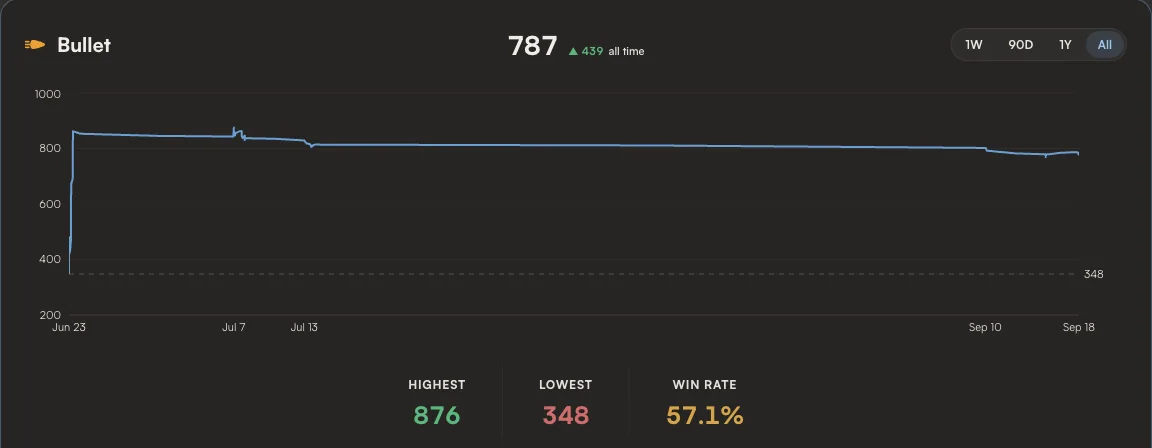
Two things are going on in this chart, and they mean very different things. The steep climb on the left, from 348 to around 850 in the first games, is not improvement. A new account starts with a rating the system knows little about, so early results move it a long way until it finds the right level. (Chess.com and Lichess use Glicko systems, which do exactly this; how Elo ratings work explains the idea behind all of them.)
The real story is everything after that: a long, gentle slide from the high 800s to 787. The averages under the chart say the same thing: 832 over the last 50 games, 802 over the last 20, 781 over the last 10. Rolling averages like these are the best way to read a trend, because a single bad night barely moves them.
Results by opponent strength
| Opponent | Win rate | Games |
|---|---|---|
| Stronger, 50 to 150 above | 14% | 7 |
| Similar, within 50 | 54% | 59 |
| Weaker, 50 to 150 below | 100% | 10 |
| Much weaker, 150+ below | 100% | 1 |
This split is one of the most useful in any history. Against similar opponents, within 50 points, this player scores 54% over 59 games: a solid, trustworthy number, and slightly above the 50% an accurately rated player should score. Against weaker opponents the score is perfect. Against stronger ones it is 14%, but over only 7 games.
The common trap in this table is losing to weaker players. If your score against lower-rated opponents is poor, you are giving away rating in games you should win, often through overconfidence or rushing. That is not the problem here. The question for this player is whether 14% against stronger opponents is real, and 7 games is not enough to say.
When you play, and when you play best
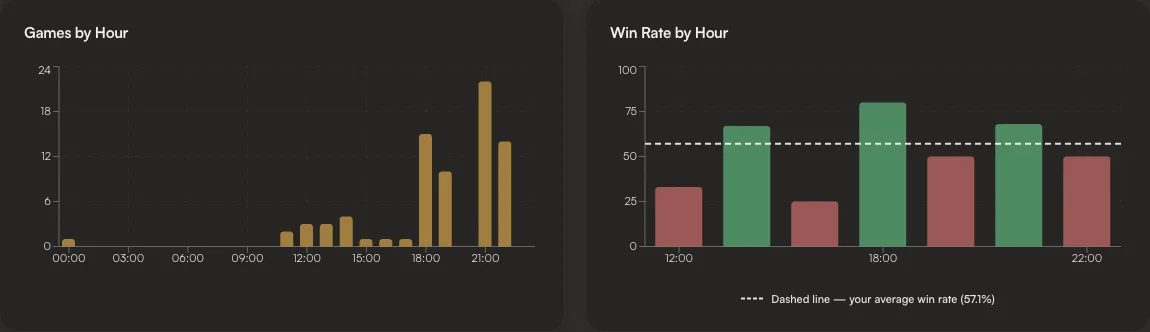
Most of the games here are played in the evening, between 18:00 and 22:00, and the busiest single day had 34 games. Win rate by hour moves around the 57.1% average line, some hours above, some below.
Charts like these are where tilt and fatigue show up. A player whose win rate falls away late at night, or whose results drop after long sessions, has found a cheap fix: play fewer games, or earlier. Thirty-four games in one day is a warning sign on its own, because very few players keep their level that long. But read the hourly bars with care: with only a handful of games in some hours, a single result moves a bar a long way.
How your games end
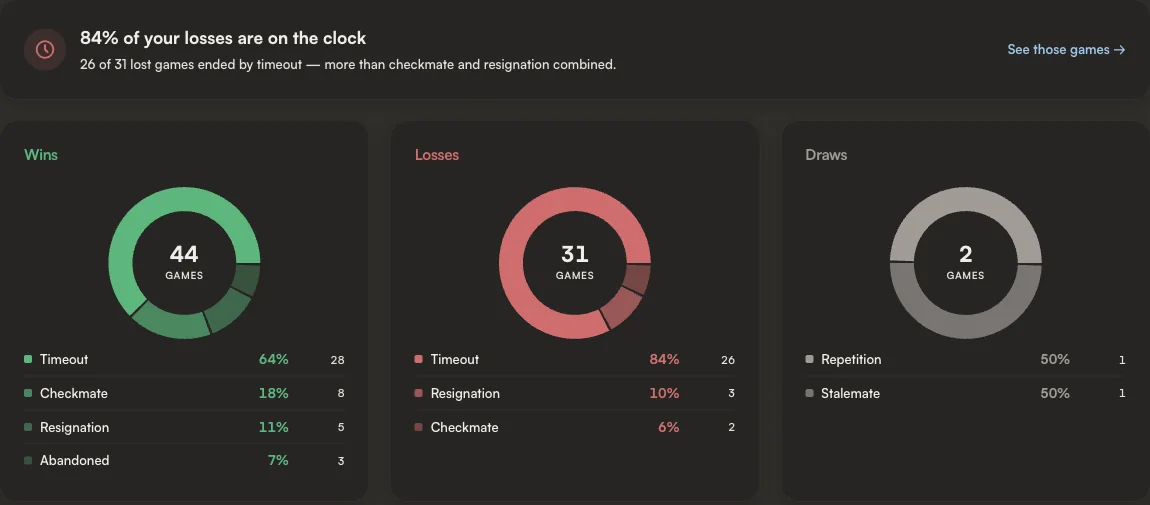
This is the clearest finding in the whole history. 26 of the 31 losses ended on time, more than checkmate and resignation combined. And the clock decides the wins too: 28 of the 44 wins came from the opponent running out of time.
That tells you what kind of games these are. They are races against the clock much more than battles on the board, and the most valuable skill is managing time, not finding better moves. It is exactly the conclusion a separate, engine-based 40-game Profile Report reached for the same player, where time management scored lowest of six skills. When your game history and an engine analysis agree, you can be confident the finding is real.
Your openings, by the numbers
This player scores 61% as White over 38 games and 54% as Black over 39: both healthy, with White slightly better. The opening lists underneath are where to be careful. Most openings in a 77-game history appear once or twice, so one list shows a line at 100% and another at 0% on the strength of two games each.
Use opening statistics for what they are good at: finding the lines you play most, and the ones that keep appearing in your losses once you have enough games. Do not drop an opening because it lost twice. When you want to know what an opening is trying to do, the openings library covers its main line and ideas, and the best openings for club players helps you choose.
The rule that keeps stats honest
Always read the number of games
Every statistic comes with a sample size, and the sample size decides whether it means anything. A result over 50 games is information. A result over 5 games is a rumour. Before you change anything about your chess because of a number, check how many games it rests on.
Applied to this history: the 54% against similar opponents (59 games) and the 84% of losses on time (31 losses) are solid. The 14% against stronger players (7 games) and every single-opening result are not, yet. They will become trustworthy as the history grows, which is why it is worth coming back to your stats every month or two.
Where to see all of this
Lumichess Insights reads your whole Chess.com or Lichess history and lays it out in tabs: Overview for your ratings and results, Openings for your repertoire from both sides, Opponents for results by strength, Patterns for when you play and how games end, Games for the full searchable archive, Compare for setting your record beside any other player's, and FIDE for official ratings. You can connect up to four accounts and read them together, which is the only way to see your real record if your games are split across two sites.
| Use | When you want |
|---|---|
| Insights | The long view: trends and habits across your whole history. |
| Profile Report | A diagnosis: six skills scored by the engine across your last 40 games. |
| Game Report | One game, move by move, when a statistic points you to a game worth studying. |
The three work together. Insights shows you what keeps happening, the Profile Report tells you which skill is behind it, and the Game Report shows you the exact moves.
Frequently asked questions
How do I see my Chess.com stats?
Chess.com shows basic stats on your profile. Lumichess Insights reads your whole public game history from your username and adds rating trends, results by opponent strength, time of day, how your games end and a full opening audit.
What is a good win rate in chess?
Around 50% against opponents of your own rating, because that is what an accurate rating predicts. Scoring well above 50% against similar opponents usually means your rating is about to rise.
Why did my rating jump so much in my first games?
A new account's rating is uncertain, so early results move it much further than later ones while the system finds your level. The first games are not a sign of improvement or decline.
How many games do I need for my stats to mean something?
It depends on the question. Results against similar opponents settle after a few dozen games. A single opening needs many more games before its score means anything.
Can I combine my Chess.com and Lichess stats?
Yes. Insights lets you connect up to four Chess.com and Lichess accounts and read them together or one at a time.
Do I play worse at night?
Your win rate by hour will tell you, once you have enough games in each hour. Many players do score worse late at night or after long sessions, and it is one of the cheapest weaknesses to fix.