Every chess player eventually asks which openings to learn. The honest answer is less exciting than most opening videos: below master level, the opening you choose matters much less than how well you understand it. A sound opening you know the ideas of will beat a sharp one you have half-memorised, almost every time.
So this guide does two things. It suggests a small repertoire for White and for Black, openings that are sound, well understood and good to learn from, and it explains the principles behind them, so that when your opponent leaves the book on move five you still know what to do.
The short version
- You need three answers: one opening as White, one reply to 1.e4 and one reply to 1.d4.
- Good choices for learning: the Italian Game or London System as White; 1...e5 or the Caro-Kann against 1.e4; the Queen's Gambit Declined or Slav against 1.d4.
- Learn ideas and plans, not long move lists. Five moves you understand beat fifteen you memorised.
- Stick with your choice long enough to learn it. Switching every month is the most common opening mistake.
The principles every good opening follows
Every sound opening, from the oldest to the most modern, is built on the same few ideas. Know them and you can find reasonable moves in any opening, including ones you have never seen:
- Fight for the centre. Pawns and pieces that control e4, d4, e5 and d5 give you space and make every other piece stronger.
- Develop your pieces. Knights and bishops off the back rank, ideally each moved once, before you start an attack.
- Castle early. A king in the centre is a target once the position opens. Castling also brings a rook towards the middle.
- Do not bring the queen out too early. It can be chased around by pieces that develop with tempo while they do it.
- Connect your rooks. When the back rank between your rooks is clear, your opening is essentially done.
Openings break these rules on purpose sometimes, for a concrete reason. But when you are unsure what to play, returning to them is almost never a mistake. And when you review your games, a lot of early trouble turns out to be one of these five, broken without a reason.
How to choose an opening
Ask three questions:
| Question | If your answer is... | Lean towards |
|---|---|---|
| Do you like open, tactical games? | Yes: you want piece play and attacks. | 1.e4 openings; 1...e5 or the Sicilian as Black |
| Do you prefer structure and plans? | Yes: you like knowing where your pieces go. | The London or Queen's Gambit; the Caro-Kann or Slav as Black |
| How much time will you spend on theory? | Very little. | System openings and solid defences with a fixed setup |
There is also a fourth, underrated question: which openings do you enjoy playing? You will play an opening hundreds of times. Pick one you like looking at.
Openings for White
The Italian Game: 1.e4 e5 2.Nf3 Nc6 3.Bc4
The classic first opening, and for good reason. White develops a knight to attack e5, then puts the bishop on c4, aiming at f7, the weakest square near Black's king. Every move follows the principles above, the plans are easy to understand, and the positions teach you how to attack. A common setup continues 3...Bc5 4.c3 Nf6 5.d3, a calm version where White prepares d4 slowly. The Italian also leads naturally to the Ruy Lopez, 3.Bb5, when you want something deeper later.
The London System: 1.d4, 2.Bf4, e3, Nf3, c3
A system rather than a line: White plays roughly the same setup against almost anything, with the dark-squared bishop coming out to f4 before e3 locks it in. A typical start is 1.d4 d5 2.Bf4 Nf6 3.e3 e6 4.Nf3 c5 5.c3. It is low on theory and high on structure, which makes it a favourite of club players who want a playable position every game. The downside is that it can become one-dimensional if you never learn what to do after the setup is complete.
The Queen's Gambit: 1.d4 d5 2.c4
White offers the c-pawn to pull Black's d-pawn away from the centre. It is not a true gambit, because Black cannot comfortably keep the pawn. It leads to rich, strategic positions and is the natural step up from the London once you want more from the opening.
Answering 1.e4 as Black
1...e5: meet the Italian and the Ruy Lopez head on
The most principled reply: put a pawn in the centre, develop, castle. You will meet the Italian and the Ruy Lopez most often, and playing both sides of them is the best way to understand open games. It asks you to know a few tactical ideas, especially around f7.
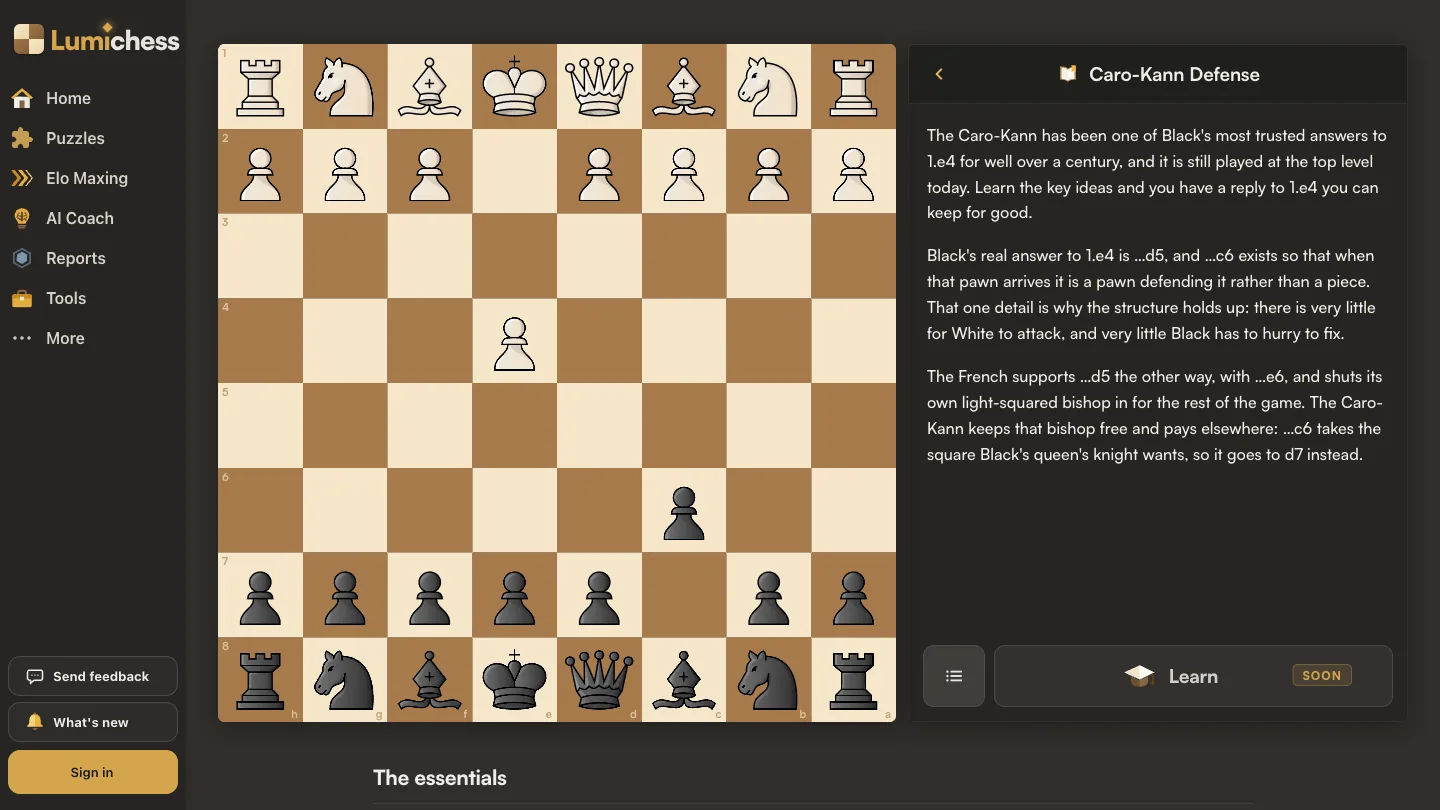
The Caro-Kann Defense: 1.e4 c6 2.d4 d5
Black prepares ...d5 with a pawn rather than a piece, so the pawn on d5 is solidly supported. The structure is hard to attack, and unlike the French Defense (1.e4 e6 2.d4 d5), Black's light-squared bishop is not shut in behind its own pawns. It suits players who like solid positions and slow plans.
The Sicilian Defense: 1.e4 c5
The most ambitious reply. Black fights for d4 from the side and creates an unbalanced position where both sides have chances. It is a superb opening and a demanding one: the main lines are deep and sharp, and White has many different ways to play against it. Consider it once you are comfortable with sharper positions and willing to study.
The Scandinavian Defense: 1.e4 d5
Black challenges e4 immediately. After 2.exd5 Qxd5 3.Nc3 Qa5 the queen comes out early, which breaks a principle for a concrete reason: the structure is simple and the plans are clear. It is a practical choice when you want to decide the kind of game on move one.
Answering 1.d4 as Black
The Queen's Gambit Declined: 1.d4 d5 2.c4 e6
Black keeps a pawn on d5 and supports it with ...e6. It has been trusted at every level for more than a century. The price is the light-squared bishop behind the e6 pawn, and much of the opening is about solving that problem at the right moment.
The Slav Defense: 1.d4 d5 2.c4 c6
The Caro-Kann idea against 1.d4: support d5 with the c-pawn and keep the light-squared bishop free. If you play the Caro-Kann against 1.e4, the Slav gives you familiar structures against 1.d4.
The King's Indian Defense: 1.d4 Nf6 2.c4 g6 3.Nc3 Bg7
Black lets White build a big centre, then attacks it, often on the kingside. It produces sharp, double-edged games. Like the Sicilian, it rewards study and is a better second opening than a first one.
A complete starter repertoire
| You need | Open, tactical | Solid, structural |
|---|---|---|
| As White | Italian Game | London System |
| Against 1.e4 | 1...e5 | Caro-Kann |
| Against 1.d4 | Queen's Gambit Declined | Slav |
Pick one column, or mix them to suit you. Either way, three openings is a complete repertoire that can last you well past 1800. Add something sharper, like the Sicilian or the King's Indian, only when you find yourself wanting more from your games.
Traps: know them, do not rely on them
Every popular opening has traps, and you should know the ones in yours, mostly so that you do not fall into them. A famous example from the Italian is Legal's Trap: 1.e4 e5 2.Nf3 Nc6 3.Bc4 d6 4.Nc3 Bg4 5.h3 Bh5? 6.Nxe5! Bxd1?? 7.Bxf7+ Ke7 8.Nd5#. White gives up the queen and mates with three minor pieces.
But do not build your openings around traps. A trap works only when the opponent makes a specific mistake, and against anyone who does not, a trap-first opening often leaves you worse. The same goes for early queen attacks like 1.e4 e5 2.Qh5: they win games at the lowest levels and lose them as soon as opponents know to develop with tempo.
How to learn an opening
- Learn the first few moves and the ideas behind them. Why does each move exist? What is each side aiming for?
- Learn the typical plans for the middlegame that follows, not only the moves. Where do the pieces go? Which pawn break matters?
- Play it, in games you do not mind losing, rapid if possible. You will learn more from ten games than from ten hours of video.
- Review the opening phase of every game. Where did you leave your preparation, and what happened next? A Game Report shows your accuracy in the opening separately from the rest of the game, and a Profile Report shows how your openings have actually performed across your last 40 games.
- Only then go deeper, into the lines that keep appearing in your games.
The Lumichess openings library covers 60 opening families, each with its main line, how often it is chosen in our game database and how those games ended. Look up the ones you face most, and use the ten-minute review routine after each game to see where your opening knowledge ran out.
Frequently asked questions
What is the best chess opening for beginners?
As White, the Italian Game (1.e4 e5 2.Nf3 Nc6 3.Bc4) is a classic first opening: every move follows opening principles and the plans are easy to understand. The London System is a good low-theory alternative.
What should Black play against 1.e4?
1...e5 is the most principled reply and teaches open games. The Caro-Kann (1...c6) is a solid alternative for players who like structure. The Sicilian (1...c5) is excellent but demanding.
What should Black play against 1.d4?
The Queen's Gambit Declined (1...d5 2.c4 e6) and the Slav (2...c6) are sound, well-understood choices. The King's Indian is sharper and better as a second opening.
How many openings do I need to know?
Three: one opening as White, one reply to 1.e4 and one reply to 1.d4. That covers the large majority of your games.
Should I memorise opening lines?
Only the first few moves at first. Understanding the ideas and typical plans matters far more, because most opponents below master level leave the main lines early.
How often should I change my openings?
Rarely. Stay with an opening long enough to understand its plans, usually months, and change only if you genuinely dislike the positions it gives you.