Open any analysis board and the engine gives you a number: +0.35, -1.88, M4. It is the most-read and most-misread number in chess. Players treat it as a score, a prediction, or a grade, and it is none of those exactly.
This guide explains what an engine evaluation is, how to read it in the three forms you will meet, and how to use several engine lines together, which is where most of the real information is. The examples come from one famous game, Byrne against Fischer, 1956, analysed on the Lumichess Analysis Board with Stockfish 18.
The short version
- An evaluation is measured in pawns: +1.00 is roughly a pawn's worth of advantage for White, -1.00 the same for Black.
- M4 means a forced mate in four moves. A minus sign means Black is the one mating.
- The number assumes best play from both sides. It is a statement about the position, not a forecast of your game.
- It changes as the engine searches deeper, so small differences mean little.
- With several engine lines on screen, the gap between the first and second tells you whether there was one move to find.
What the number is
An engine searches ahead through the possible moves, and at the end of each line it judges the position: material, king safety, piece activity, pawn structure and much more. It then works back to the move that gives the best result against the best defence. The evaluation is its judgement of the position if both sides play that way.
The unit is the pawn. Engines count internally in centipawns, hundredths of a pawn, so 150 centipawns is shown as +1.50. On most boards, including the Lumichess one, the number is given from White's side: a plus sign means White is better, a minus sign means Black is. The bar beside the board shows the same thing as a share of the bar.
Material is only part of it. An engine will happily show +1.00 for White with material level, because White's pieces are so much more active that it is worth about a pawn. That is the useful thing about the number: it puts every kind of advantage into one currency.
How big is big?
There is no fixed scale that turns a number into a verdict, because the same number means different things in different positions. A few anchors help:
| Evaluation | Roughly the value of |
|---|---|
| 0.00 | Balanced, or a forced draw |
| +1.00 | A pawn |
| +3.00 | A knight or bishop |
| +5.00 | A rook |
| +9.00 | A queen |
Context changes the meaning. A one-pawn edge in a rook endgame is often a draw with good defence. A one-pawn edge with the opponent's king stuck in the centre can be close to winning. And in practical terms, an advantage matters more the lower the rating: two club players at +1.50 will often see the result swing several times before the game ends. That is why the Lumichess Game Report labels moves by how much they change the winning chances, not by the raw drop in the number.
Mate scores
When the engine finds a forced checkmate, it stops showing pawns and shows the mate instead. M4 means the side to move can force mate in four of its own moves, whatever the defence does. -M4 means Black is the one mating.
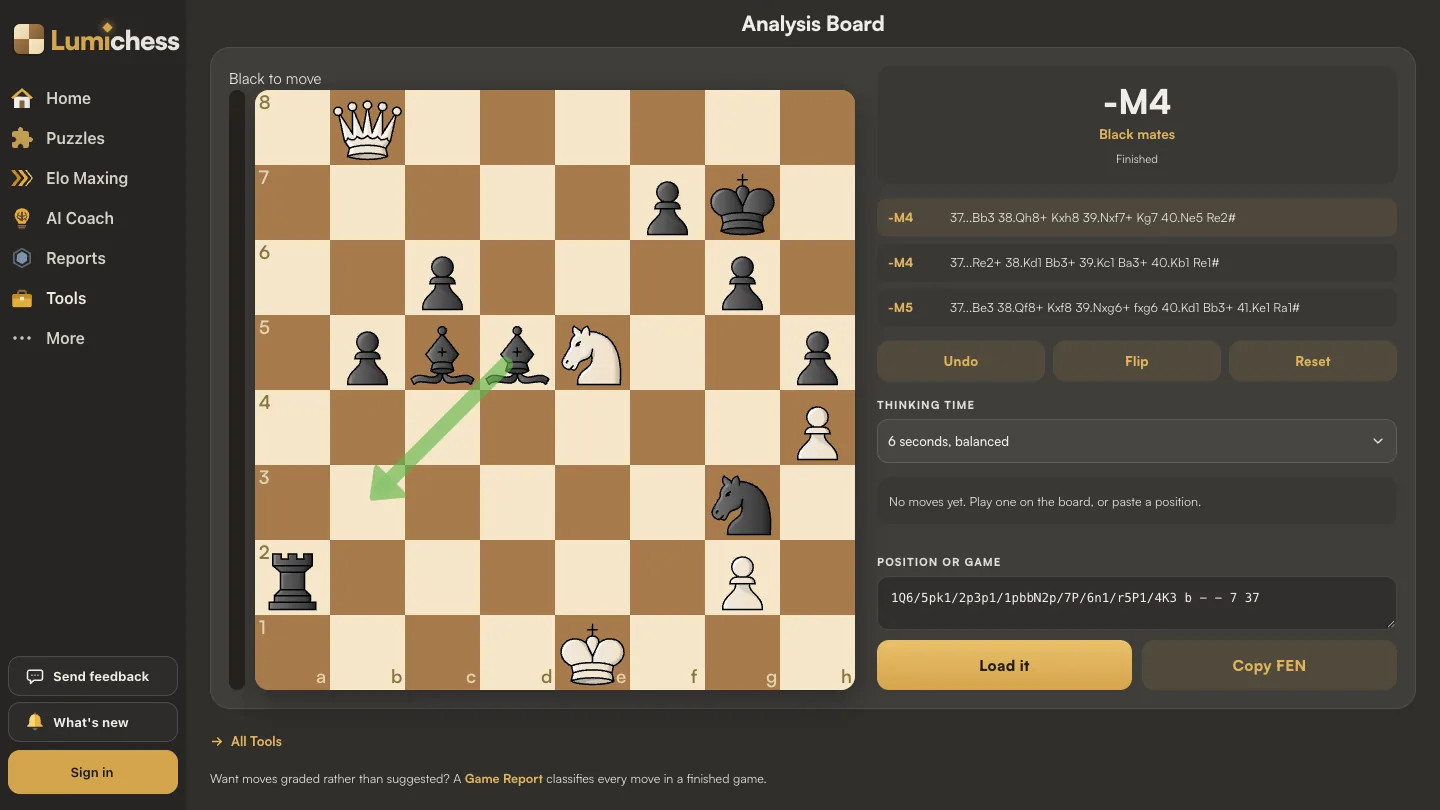
This is the final phase of the Game of the Century, after White's 37th move. The engine finds a mate in four starting with 37...Bb3, and a second one starting with 37...Re2+. Fischer played 37...Bb4+ and mated in five, finishing with 41...Rc2#. His way was one move slower than the engine's, and it made no difference at all: a forced mate is a forced mate. That is worth remembering when you review your own won games. A slower win is not a mistake.
Reading several lines at once
A good analysis board shows more than one line. The Lumichess Analysis Board shows the engine's three best moves, each with its own evaluation and continuation. That comparison is often more useful than the top number.
Here is the position after 11.Bg5, the move that has been called White's decisive mistake in the Game of the Century, with Black to play:
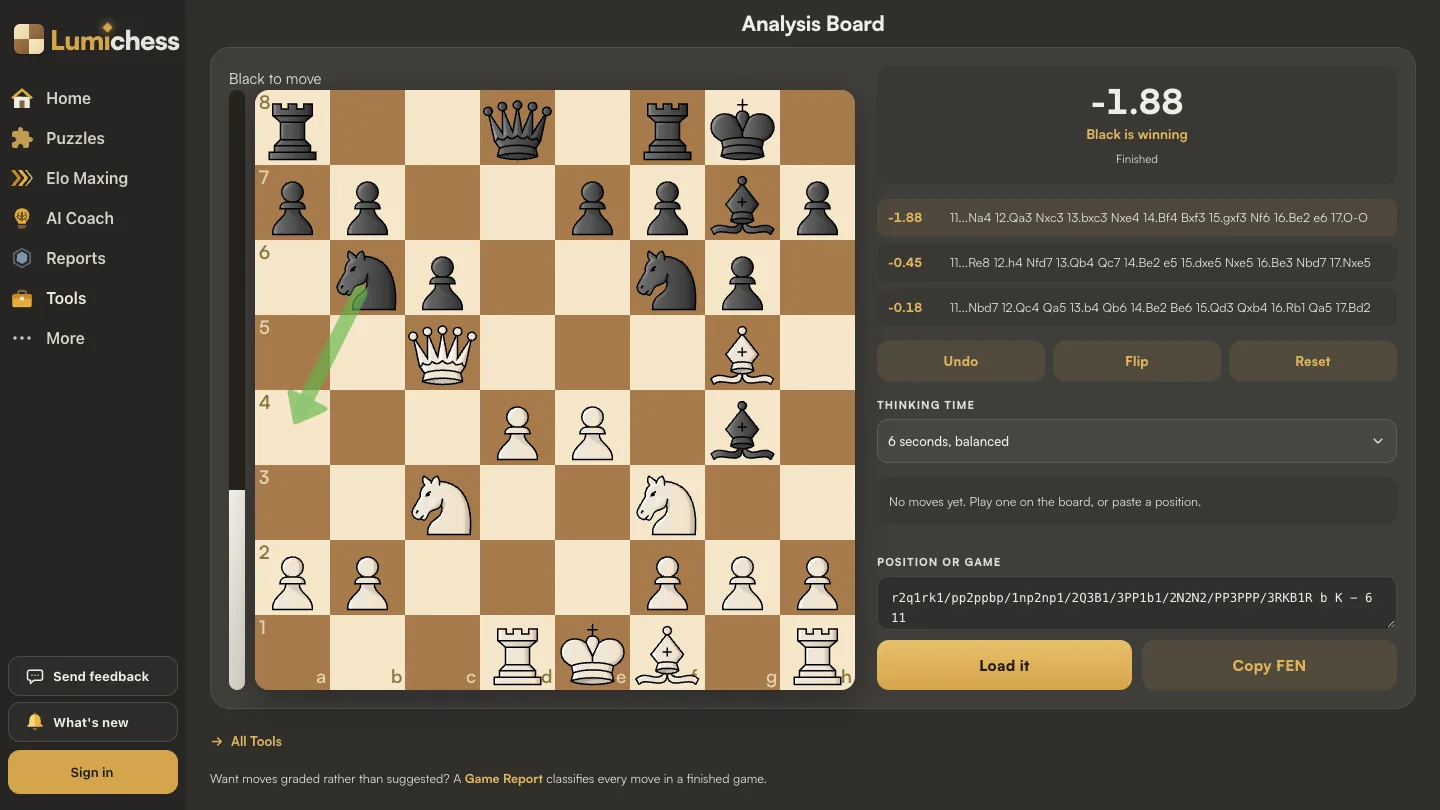
Read the three lines together. With 11...Na4, the move Fischer played, Black is clearly better at -1.88. With the next best move, 11...Re8, Black is only slightly better at -0.45, and with 11...Nbd7 the position is close to level. The gap between the first line and the second is well over a pawn.
That gap is the real information. It says 11.Bg5 was a mistake only if Black finds one particular move. Play anything natural and the position is roughly equal. When the lines sit close together, the position has several good answers and missing the top one costs little. When the first line stands far above the rest, as here, there was one move to find, and those are the positions worth studying from your own games.
Read the line, not just the number
Each evaluation comes with the moves the engine expects. Step through them. 11...Na4 12.Qa3 Nxc3 13.bxc3 Nxe4 shows the idea at once: Black removes the defender of e4 and wins a central pawn with a lead in development. A number you cannot explain teaches you nothing; the line is where the explanation is.
Why the number keeps changing
An engine searches deeper the longer it runs, and each deeper search can change its mind. In a quiet position the number settles quickly. In a sharp one it can move by a pawn or more as the engine finds a hidden resource.
You can see this in the examples above. The position after 11.Bg5 reads -1.88 on a six-second search on the Analysis Board, while the full-game review in the Game Report put it at -1.61. Same position, same engine, different search. Both say the same thing: Black is clearly better. The difference between them does not matter.
Two practical rules follow. First, do not read meaning into small differences: -0.20 and -0.35 are the same assessment. Second, when a position is sharp and you want to trust the number, give the engine more time. The Analysis Board lets you choose 3, 6 or 12 seconds per position, and how deep it gets in that time depends on your device.
An evaluation is not a prediction
The number assumes that both sides keep finding the best moves. That is roughly true in engine games and not at all true in yours. A position at +2.00 in a blitz game between club players is not "White wins"; it is "White wins if White keeps playing accurately", which is a different claim.
The reverse is also true. A position at -1.00 can be easy to play for White and hard for Black if Black's only good moves are difficult to find. Engines do not measure difficulty. That is why reviewing your games with an engine is most useful when you ask not only "what was best?" but "could I have found it?", which is the heart of the ten-minute review routine.
Common misreadings
- Reading the sign the wrong way round. Most boards show the number from White's side, but a few show it from the side to move. Check which before you panic.
- Treating 0.00 as "equal chances". It often means a draw with best play, which can still be a position only one side can realistically lose.
- Chasing the top move. If the second line is within a few hundredths, both moves are fine. Pick the one you understand.
- Trusting the number without the line. An evaluation of +3.00 means nothing to you until you see what White wins and how.
- Checking during a game. Using an engine while a game is being played breaks the fair play rules of every chess site. Analysis is for after the game.
To check a single position quickly, the Best Move Finder gives the move, the evaluation and the next two choices; how to find the best move walks through reading its answer. To set up a position from a book or a diagram first, use the Position Editor.
Frequently asked questions
What does +1.5 mean in chess?
White is better by roughly the value of one and a half pawns, assuming best play from both sides. The advantage can come from material, activity, king safety or structure.
What does M4 mean on a chess engine?
A forced checkmate in four moves by the side the sign favours. M4 means White mates, -M4 means Black mates, however the other side defends.
Is the engine evaluation from White's or Black's side?
On most analysis boards, including Lumichess, from White's side: plus is good for White, minus is good for Black. A few tools show it from the side to move, so check.
What is a centipawn?
A hundredth of a pawn. Engines count in centipawns internally, so an evaluation of 150 centipawns is shown as +1.50.
Why does the evaluation change while the engine is thinking?
Each deeper search can find new resources for either side. Quiet positions settle fast; sharp ones can move by a pawn or more. Small differences between searches do not matter.
Does a winning evaluation mean I should win the game?
Only if you keep finding strong moves. The evaluation assumes best play from both sides, which rarely happens below master level.